Workplace Stress Is Getting Worse: Data & What Actually Helps


Nearly half of people we've assessed (47%) have experienced high or very high stress in the past two weeks. If that's how you've been feeling lately, you're not alone. What our data also tells us is that while stress is relatively easy to recognise, knowing how to manage it is much harder. The fact that you're reading this matters. You're not ignoring it. You're looking for a way to handle it better, whether that's for yourself or for the people in your organisation. So let's dig into what's really going on.
Stress Levels Are Rising, and They Have Been for Years
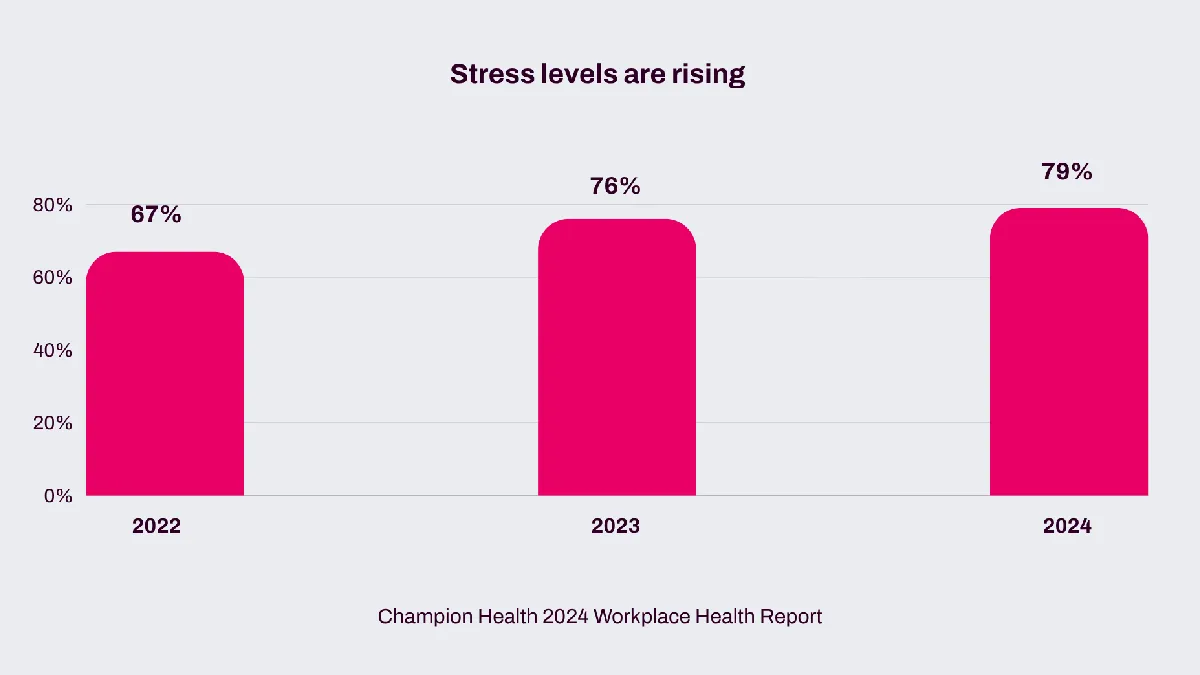
According to our 2024 Workplace Health Report, 79% of employees are now experiencing moderate-to-high levels of stress at work. That's up from 76% in 2023, and 67% in 2022. A 14% increase in just two years.
This isn't an individual problem. It's a workforce-wide one.
What's also worth noting is the shift in the nature of that stress. In 2024, the proportion of people experiencing helpful, motivating stress dropped from 54% to 51%, while levels of unhelpful stress crept up. The kind of stress that drives performance is becoming harder to find. The kind that drains people is becoming more common.
Stress and Burnout Are Not the Same Thing
These two words get used interchangeably but they're actually quite different.
Stress is typically a response to pressure. It can be temporary and recoverable, especially when it comes in manageable doses. Many people function well under a certain level of stress; it keeps them focused and motivated.
Burnout is what happens when that pressure is sustained for too long without recovery. It's not just tiredness. It's a state of complete physical and emotional depletion that makes it difficult to function, connect with work, or feel anything other than flat.
One data point that points clearly toward burnout risk in our workforce: 48% of employees now report feeling fatigued, up from 40% the previous year. When nearly half your workforce is running on empty, burnout isn't a distant risk. It's a present reality for many people.
So What's Actually Causing the Stress?
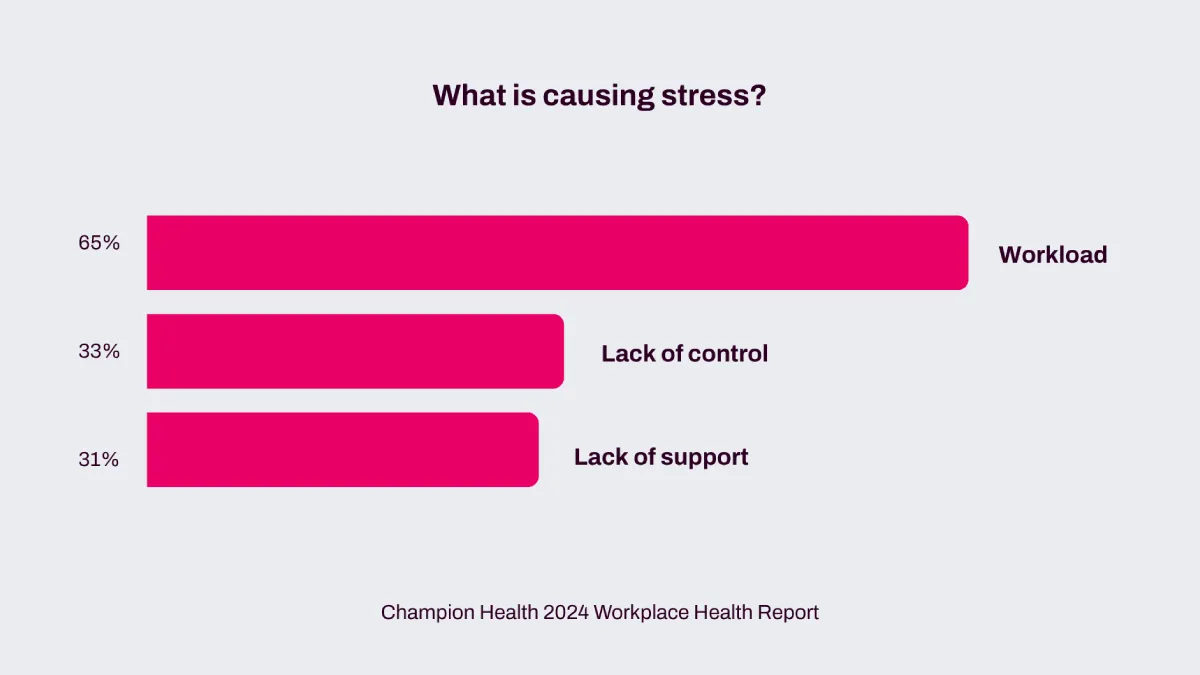
Workload is the biggest single driver, cited by 65% of people experiencing unhelpful stress at work. Just as important: the second and third biggest causes are lack of control (33%) and lack of support (31%).
This tells us something important: stress isn't just about having too much to do. It's also about not feeling trusted to manage your own work, and not feeling backed up when things get hard. Both of those are things organisations and leaders can actively change.
Outside of work, financial pressure has become the top stressor for 41% of people (up from 37% the previous year), and 1 in 2 parents cite parenting as a significant cause of stress. Stress doesn't clock out when your laptop closes. It follows people home, and it shows up at work the next morning.
Who is Most Affected?
Stress does not affect everyone equally.
Women are significantly more likely to experience unhelpful workplace stress than men (61% versus 37%), and that gap has widened since last year. The reasons are complex and structural: gender inequality in pay and progression, greater caring responsibilities, and a mental load that often goes unseen.
Young people are also struggling more than any other group. Stress in 16 to 24-year-olds has increased by 50% in a single year. Precarious employment, financial anxiety, and a constant digital environment are colliding in ways we're only beginning to fully understand.
If you're a leader reading this, these aren't abstract statistics. They're likely a description of people on your team right now.
The Cost of Getting This Wrong
Beyond the human impact (which should be reason enough to act), there's a real business cost to high levels of stress in the workforce.
Employees experiencing unhelpful stress take an extra 8 sick days per year on average. High stress is the second biggest self-reported drain on productivity, behind only tiredness, and nearly 70% of employees rate their productivity as average or below.
The connection runs deep. People who don't feel supported at work score notably lower on both wellbeing and productivity measures. Culture isn't just about how a place feels. It directly influences how well people perform.
What Actually Helps: For Individuals
There's no single fix, but there are approaches with good evidence behind them. A few that are worth knowing:
Learn to recognise your early warning signs. By the time burnout is obvious, it's often been building for months. Irritability, difficulty concentrating, disrupted sleep and a sense of going through the motions are all signals worth paying attention to.
Work with your energy, not against it. Our data shows the average employee is most energised at around 10am and least energised at around 3:30pm. Protecting your peak hours for demanding work, and using lower-energy periods for admin, is a simple but underused strategy.
Prioritise sleep. 71% of employees rate their sleep as average or worse. Poor sleep doesn't just make you tired. It makes stress feel more intense and recovery feel impossible. It's worth treating as a health priority, not a luxury.
Address the stress response physically. Breathing techniques, regular movement and time outside aren't wellness clichés. They work physiologically to reduce cortisol levels and interrupt the stress cycle. Even short, frequent breaks make a measurable difference.
Talk about it. Our data shows that 1 in 2 employees have accessed mental health support at some point in their lives. Seeking help isn't weakness. In 2024, more people are reaching out, which is one of the most encouraging findings in our data.
What Actually Helps: For Organisations
Individual tools only go so far when the environment itself is generating stress. Three of the top five causes of workplace stress (workload, lack of control and lack of support) are things that leaders and organisations can directly address.
Some of the most effective things we see employers doing:
Working with managers on how they handle workload conversations, not just at appraisal time, but as an ongoing, normal part of how teams operate. Giving people genuine autonomy over how they structure their work, not just what they deliver. Building a culture where it's normal to flag when things are too much, before it reaches crisis point. Being deliberate about not normalising always-on working: office and hybrid workers are already more likely to work an extra unpaid hour a week, and leaders modelling boundaries matters.
The organisations doing this well aren't just healthier places to work. They're also more productive ones.
A Note on Where to Start
If you're an individual reading this and recognising yourself in some of what we've described: the most useful thing you can do is pick one thing, not ten. What's one small change you could make this week that would give your nervous system a bit more room?
If you're an HR leader or People professional: the data suggests that stress in your workforce is almost certainly higher than it was two years ago. The question isn't whether to act. It's which lever to pull first.
At Champion Health, we work with organisations to help them understand the real health picture of their workforce, and give people the tools to do something about it. If you'd like to explore what that looks like in practice, we'd love to talk.
Data referenced in this article is taken from The Champion Health Workplace Health Report 2024, based on health assessment data from over 4,300 employees. All data is self-reported.
