The Biopsychosocial Model: Why Workplace Rehabilitation Needs to Treat the Whole Person

Key Takeaways
- The biopsychosocial model explains health as the product of biological, psychological, and social factors working together, not a single physical cause acting on its own.
- Pain and illness are shaped by tissue damage, stress, beliefs, and circumstances like job security, so identical injuries can produce very different recoveries.
- Treating one dimension in isolation, physio for a bad back or an EAP call for stress, leaves the other drivers intact and the problem tends to return.
- Effective return-to-work plans address workload, job design, and psychological safety alongside physical recovery rather than treating the presenting symptom alone.
- Prevention works best when it surfaces early mental and physical signals together, shifting workforce health strategy from reactive case-by-case treatment to whole-person design.
What the Biopsychosocial Model Actually Says
The biomedical model treats pain as a straightforward reading of physical damage. More tissue damage means more pain. Fix the tissue, fix the pain. That model works well for a broken bone. It falls apart with most of the persistent pain people bring to work.
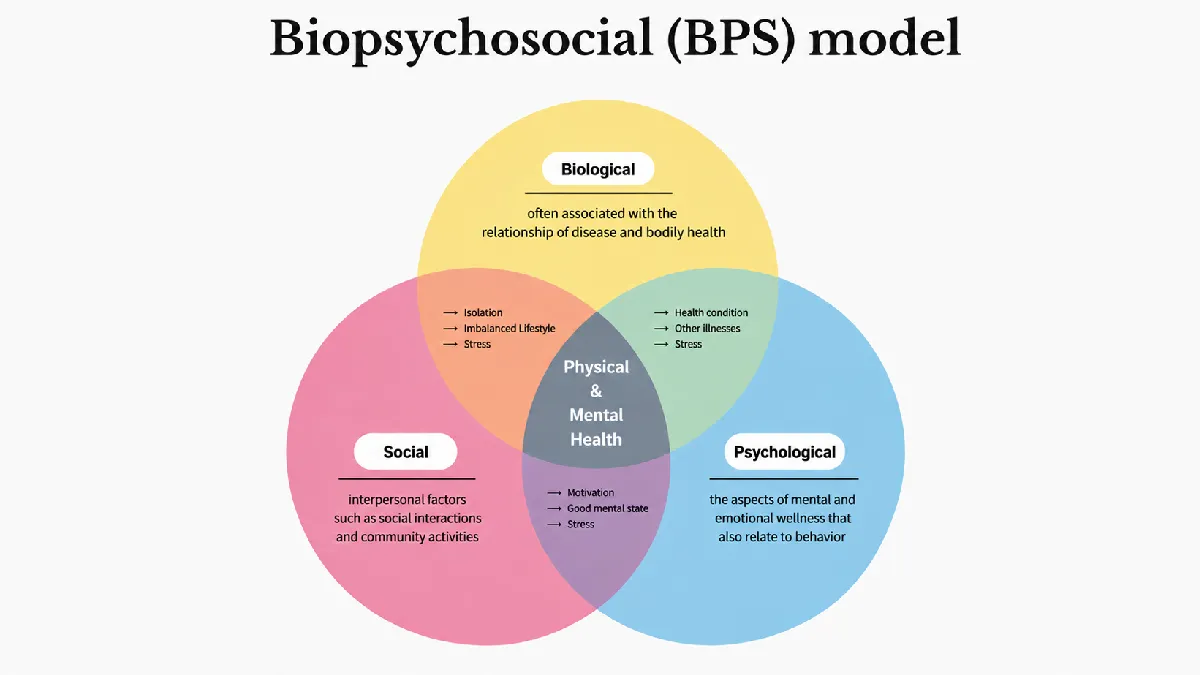
The biopsychosocial model gives a fuller account. It says pain and illness come from three sets of factors working together. Biological factors cover the tissue, the injury, and the physical state of the body. Psychological factors cover stress, mood, fear, and what a person believes about their symptoms. Social factors cover the job, relationships, and financial pressure.
The clearest example is how pain actually works in the body. Pain is not a fixed signal sent straight from the injured spot to the brain. The nervous system turns that signal up or down before you feel it. Stress, fear, and low mood turn it up. A back scan can look identical for two people, yet one is in agony and the other feels almost nothing. The difference is not the tissue. It is how the whole system is processing the signal.
This is why the biopsychosocial model of pain matters at work. Someone worried about their job or under constant pressure will often feel more pain from the same injury than a colleague who feels secure. The injury has not changed. The context around it has.
The point is not that pain is imaginary. It is real and physical. The point is that treating only the tissue ignores the parts of the picture that decide how much someone hurts and how quickly they recover. Treat the whole person, and you treat the actual cause.
Why Treating MSK or Mental Health in Isolation Misses the Root Cause
Take an employee with lower back pain. A physiotherapist can assess the injury and prescribe exercises. That treats the biology. But the same person is also stressed about hitting deadlines, and they have heard redundancies are coming. Stress raises muscle tension and heightens pain. Worry about job security stops them resting or asking for lighter duties, because they want to look reliable. The back injury is real. So are the two other forces pressing on it.
Physio alone addresses one part of that. It does nothing about the workload driving the tension, or the insecurity stopping the person from managing their recovery. The pain lingers. The employee assumes the treatment failed. The reinforcing loop stays intact, because only one of three drivers was touched.
Now run it the other way. An employee is burning out. They report headaches, poor sleep, and a churning stomach. Those symptoms are physical, so they might see a GP or reach for painkillers. The root cause is psychological and social. Too much work, too little control, and no sense that anyone will act if they raise it. Treating the headache does not fix the workload. The symptoms return, often worse.
The pattern is the same in both cases. Biological, psychological, and social factors feed each other. A single-lens response picks one thread and pulls it, while the others keep tightening the knot.
Most workplace support is built for single-lens responses. Send the bad back to physio. Route the stress to an EAP call. Each pathway does its job in isolation. Neither one looks at how the drivers combine, so neither one breaks the loop.
The lesson for employers is not that physio or EAPs are useless. They help. But when someone presents with a physical problem and a psychological one at once, treating only the symptom in front of you leaves the cause in place.
Designing Return-to-Work and Prevention Around All Three Dimensions
A biopsychosocial view changes what a good return-to-work plan actually contains. Most plans still centre on physical recovery. They set graded activity targets, adjust hours, and track pain or mobility. Physical recovery matters, but it stalls when the job someone returns to still carries the workload, the pace, or the interpersonal strain that fed the problem. A plan that ignores those drivers sends people back into the same conditions that broke them.
Address job design and workload as part of the plan, not as a separate HR conversation. If a warehouse worker's back pain flared under unrealistic lifting quotas, restoring physical function without adjusting the quota guarantees a relapse. The same logic applies to psychological load. Someone returning after burnout needs clarity on what has changed about their responsibilities, their manager's expectations, and their control over how work gets done. Psychological safety belongs in the plan too. People recover faster when they can raise a setback early without fear that it counts against them.
Prevention runs on the same logic, earlier. Reactive support waits for someone to report a problem, then routes them to a single pathway. A physio referral for the shoulder. An EAP call for the anxiety. That model treats each dimension as if it arrived alone. Prevention designed around the whole person surfaces early signals across physical and mental health together, before either hardens into a case. A rise in poor sleep, low mood, and neck tension in the same person is one signal, not three. Systems that treat them as one catch the loop while it is still cheap to interrupt.
Prevention should run through your whole workforce health strategy as a design principle, not as case-by-case treatment. Instead of asking which service to send someone to after they break, you ask how the work, the support, and the recovery pathway account for all three dimensions from the start. This does not require every manager to become a clinician. It requires the people who design roles, workloads, and support to stop assuming a physical problem has only a physical cause, and to build support that reflects how these factors compound.
Building Whole-Person Thinking Into Everyday Workforce Support
Most workforce health programmes still run mental health support and musculoskeletal support as two separate tracks, which forces an employee with back pain and mounting anxiety to enter through one door and leave the other problem untouched. A single self-management content library that holds both mental health and MSK resources in one place mirrors how the biopsychosocial model works, because it lets someone address the physical strain and the psychological load in the same session rather than picking one to prioritise. That structure matters when the two drivers are reinforcing each other, since resolving only half the loop tends to bring the other half back.
This approach adds most value in prevention rather than treatment. A well-designed library surfaces early biopsychosocial signals such as a recurring niggle in the lower back, sleep that has slipped, or stress that is climbing, and gives the person practical ways to act on them before those signals harden into something that needs clinical care. Catching a problem at the self-management stage is cheaper and less disruptive than managing a formal absence, and it keeps people in work while they recover rather than after.
The identify, prevent, escalate model does real work here. The identify stage uses assessment to show a person where their pressure points sit across physical and mental health, so the picture is whole rather than partial. The prevent stage points them to targeted self-management content that addresses those specific drivers together. The escalate stage recognises the limit of prevention and routes people who need clinical input toward it, which keeps the whole-person layer honest about what it is and is not.
Champion Health operates as that prevention layer, not as a clinical treatment provider. Our combined MH and MSK content library gives employers a way to apply biopsychosocial thinking across a whole workforce at once, rather than case by case after problems have already escalated. For an HR or People leader, the practical gain is a single mechanism that catches physical and psychological risk early, in the same place, and hands off cleanly to clinical support when self-management is no longer enough. That design turns the biopsychosocial model from a clinical theory into something an employer can actually run at scale.
FAQs
What is the biopsychosocial model in simple terms?
It says health outcomes come from three interacting factors, not one. Biology (tissue, nerves, physiology), psychology (mood, stress, beliefs about symptoms), and social circumstances (job demands, relationships, financial pressure) all shape how someone experiences illness and how quickly they recover.
How is the biopsychosocial model different from the biomedical model?
The biomedical model treats the body like a machine with a broken part to find and fix, assuming symptoms map directly onto physical damage. The biopsychosocial model, proposed by George Engel in 1977, adds psychological and social factors because physical damage alone does not reliably predict pain or recovery.
What is the biopsychosocial model of pain?
It explains why pain does not track tissue damage in a straight line. The nervous system interprets signals rather than simply reporting them, so stress, fear, and beliefs about a symptom can amplify or dampen the pain someone feels from the same physical input.
Why does treating MSK or mental health separately not work?
Because the two reinforce each other. Stress raises pain sensitivity, pain disrupts sleep, poor sleep lowers tolerance for workload pressure, and workload pressure feeds the original stress. Treating only one node in that loop leaves the rest of it running, so the problem tends to return.
How should employers apply the biopsychosocial model to return-to-work plans?
By addressing job design, workload, and psychological safety alongside physical recovery, rather than only tracking pain or mobility. A plan that sends someone back into the same conditions that caused the problem, without adjusting them, tends to produce a relapse.
The Takeaway for HR and People Leaders
Whole-person design prevents more problems than siloed treatment does. When you treat only the back or only the stress, the other drivers keep pulling the person back down. When you address physical, psychological, and social factors together, you break the loop earlier and at lower cost.
For HR and People leaders, the practical shift is to stop routing every case into a single pathway. Build return-to-work plans that cover workload and job design, not just physical recovery. Surface early signals across mental and physical health in one place, before they need clinical support.
The strongest prevention strategy treats the whole person, not the presenting symptom.
If you want to see how this works at scale, Champion Health combines mental health and MSK self-management support in one place, built around identify, prevent, and escalate.
Citations
Engel, G. L. (1977). The need for a new medical model: a challenge for biomedicine. Science, 196(4286), 129-136.
