
Executive Summary
- Sickness absence data and Bradford Factor scores are lagging indicators. They tell you what an absence already cost, not where risk is building before it turns into lost days.
- A proper health risk assessment measures mental health and musculoskeletal risk together, at cohort level. Those two categories drive around 70% of work-related absence, yet most assessments treat them separately or skip them entirely.
- Physical screening alone misses the interaction between stress and pain, and an aggregate wellbeing score hides which teams, roles, or sites carry the real risk.
- Run a baseline, then pulse regularly. An annual-only snapshot reintroduces the same lag you were trying to escape.
- This guide builds toward a three-stage operating model: Identify risk, Prevent at scale, and Escalate when required.
What a workforce health risk assessment actually is
A workforce health risk assessment is a diagnostic exercise that measures where health risk is building across your whole workforce before it turns into absence, turnover, or long-term sickness. It runs at population level. You gather data from employees on their physical health, mental health, and musculoskeletal strain, then read the patterns across teams, roles, and locations rather than treating each response as an individual case.
That population lens separates an HRA from an annual health screening. A screening checks one person against clinical thresholds and hands them a private result. An HRA reads the cohort, so it can surface that a specific department is showing early signs of burnout while another carries heavy MSK risk from the same repetitive task.
It also differs from a generic wellbeing survey. Most engagement surveys ask how people feel about work. A proper HRA asks structured, validated questions about actual health markers and converts the answers into a risk map you can act on.
Once you hold that map, the limits of your existing data become obvious. Sickness absence figures and Bradford Factor scores measure what has already happened, and the next section explains why that timing leaves you a step behind the risk.
Why sickness absence data and Bradford Factor scores miss the risk building underneath
Sickness absence data records what has already cost you money. By the time a name appears in an absence report, the risk that produced it has been building for weeks or months, and the report only counts the days lost after the fact. That timing is the problem. You are looking at an outcome, and the causes that drove it have long since taken hold.
The Bradford Factor makes this worse by design. It weights frequency over duration, so an employee taking several short absences scores far higher than one taking a single long spell. The formula was built to flag patterns of repeated short-term absence, and it does that job. What it cannot see is the person who never takes a day off at all.
Consider three common situations. Someone with early-stage burnout who keeps turning up while performing at half capacity generates no absence signal. A warehouse worker managing low-grade back pain who has not yet needed a day off contributes nothing to any Bradford score. An anxious employee working through it silently registers as perfectly present. Each of these carries real, escalating risk that your absence figures cannot register until it converts into leave.
Presenteeism is where most of this hidden cost sits, and no frequency-based measure detects it. HR teams working from absence data alone are responding to a signal that arrives too late to act on. You intervene after the resignation, the long-term sick note, or the referral, when the window to prevent any of them closed months earlier. A health risk assessment reads risk while it is still forming, before it hardens into the numbers an absence report can finally see.
What a good health risk assessment measures
A good health risk assessment measures mental health and musculoskeletal risk together, at cohort level, alongside physical health rather than after it. Most assessments treat mental health as an optional wellbeing pulse and musculoskeletal health as an ergonomics checklist, run separately if they run at all. Physical screening flags who might develop a chronic condition over years. It says almost nothing about who is close to burnout this quarter, or whose back pain is about to turn into a fortnight of absence.
Assessing these two categories separately breaks the picture apart, because in real people they feed each other. Chronic stress raises muscle tension and lowers pain tolerance, so a stressed employee reports more pain from the same physical load. Persistent pain then drives anxiety, poor sleep, and low mood, which pushes the stress higher again. Assess mental health and MSK on different surveys, months apart, and you never see that loop closing inside the same person. Together, these two categories drive around 70% of work-related absence, and any assessment that misses their interaction misses most of the risk it claims to measure.
Cohort level means you segment results by team, role, or location instead of reporting one blended score for the whole organisation. An aggregate wellbeing score of 6.5 out of 10 hides the warehouse team sitting at 3 and the finance team sitting at 8. Break the same data down by cohort and you can see that night-shift operators carry most of the MSK risk, or that one regional office reports far worse mental health after a restructure. That level of detail turns a number into a decision about where to send support first.
An aggregate score tells the board how the workforce feels on average. A cohort map shows you which fifty people to act on before their risk becomes a resignation, a grievance, or six weeks of statutory sick pay.
How often to run a health risk assessment
A single annual assessment reintroduces the exact lag problem that makes absence data unreliable. Workforce risk moves faster than that. A team that looked healthy in January can be showing early burnout signals by April after a demanding quarter, and an annual snapshot will not catch it until the following year.
Run a full baseline assessment once, then pulse specific cohorts every quarter. The baseline gives you a complete picture across mental health and MSK risk. The quarterly pulses track whether flagged cohorts are improving or deteriorating, so you see risk changing rather than reading last year’s version of it.
Certain events should trigger an off-cycle reassessment regardless of the calendar. A restructuring, a change to return-to-office policy, or a merger shifts workload and stress in ways your last baseline cannot account for. If a cohort flags as high-risk during a pulse, reassess that group sooner rather than waiting for the next scheduled round. Measure more often so you can act before a warning becomes a wave of absence.
How to act on the results
An assessment that produces a report nobody acts on has cost you time and told you nothing you will use. The value of an HRA sits entirely in what you change once you can see the risk. Treat the results as a routing exercise, not a scorecard to file.
Start by separating two kinds of response, because they solve different problems. Organisation-wide action addresses risk that shows up broadly across your workforce. If your assessment shows poor sleep, low movement, or rising stress spread across most teams, the fix is a preventive programme every employee can reach. Targeted support is different. When a specific cohort flags high, a customer service team carrying heavy musculoskeletal risk, or a department showing early burnout, that group needs a focused intervention aimed at their particular problem.
Most employers get this wrong by defaulting to one generic wellbeing initiative and hoping it covers everyone. A single yoga programme or an EAP relaunch does nothing for a team whose real risk is chronic back pain from workstation setup. When one initiative tries to answer every risk at once, it dilutes its effect and misses the cohorts who need the most help.
A better approach routes results into a tiered response matched to severity. Low and moderate risk across the population goes into preventive action at scale. High-risk cohorts get targeted programmes built for their specific driver. Individuals showing clinical-level risk get escalated into support that a wellbeing programme cannot provide alone. The next section sets out these three tiers in full.
The Identify, Prevent at Scale, Escalate model
A three-stage operating model turns an assessment into a response. Identify the risk building across your workforce, prevent it at scale before it spreads, and escalate the cases that need individual clinical support.
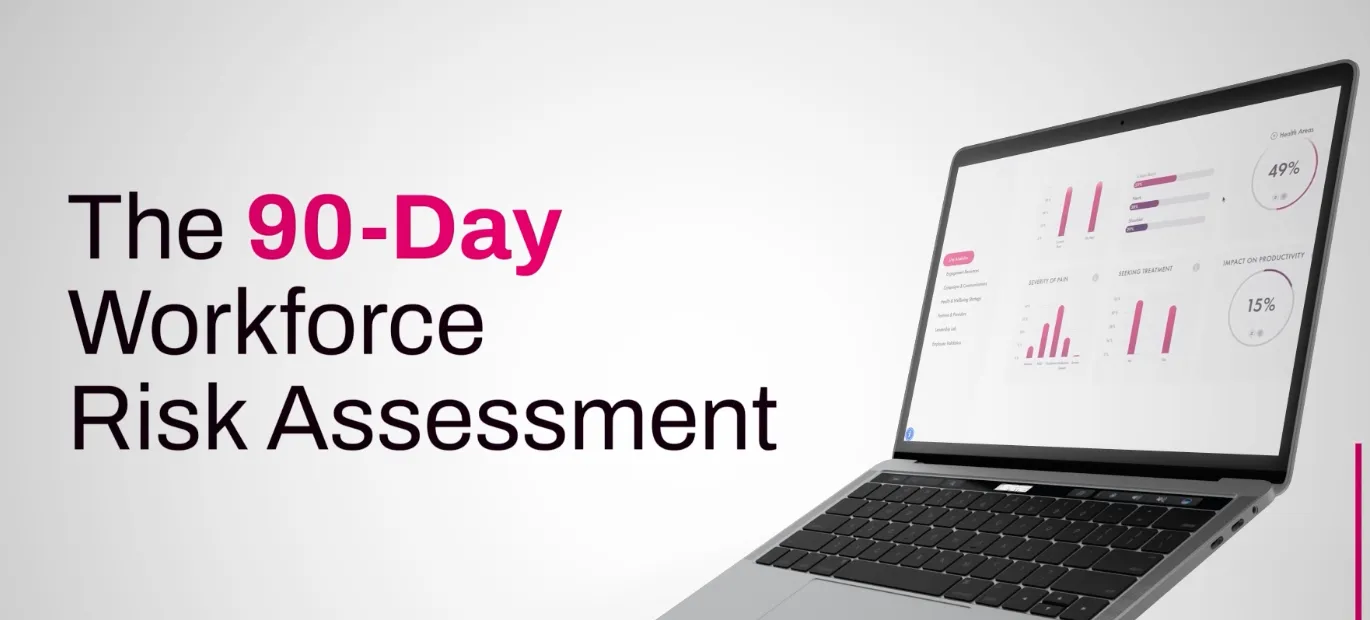
The Identify stage is where a health risk assessment does its work. At Champion Health, we run this as a 90-Day Workforce Risk Assessment. Over that window, employees complete a validated health check covering mental health, musculoskeletal risk, sleep, movement, nutrition, and lifestyle factors. The results segment by team, role, and location, so you see which cohorts carry the most risk rather than a single blended score. A 90-day baseline gives you enough completed assessments to trust the pattern, and it sets the reference point every later pulse measures against. You end this stage knowing where risk sits and what is driving it.
Prevent at Scale acts on the patterns the assessment surfaces. If a cohort shows early musculoskeletal strain from a role change, you push targeted movement and ergonomic support to that group before pain turns into absence. Preventive action works best when it reaches whole cohorts at once, because most risk is shared across a team long before any one person books time off. Reaching them early reduces the number of people who ever reach a crisis.
Escalate handles the cases prevention cannot. A minority of employees will show risk severe enough to need clinical intervention, and the assessment flags them so they route into support quickly rather than waiting for a breakdown. That might mean a GP, a mental health practitioner, or physiotherapy.
Together, Identify tells you where to look, Prevent at Scale reduces the volume of risk, and Escalate catches what slips through.
Conclusion
Most HR teams still run on absence reports. By the time those numbers move, the risk has already turned into cost. The shift worth making is to diagnose where mental health and musculoskeletal strain are building across your workforce before either shows up as a day off.
Run a proper assessment that reads both categories at cohort level. Act on what it finds with preventive support broadly and targeted help for the teams flagged as high risk. Do that consistently, and you stop reacting to last quarter and start managing the next one.
Sources
- Health and Safety Executive, Working days lost in Great Britain, 2024/25 statistics.
- CIPD and Simplyhealth, Health and Wellbeing at Work 2025.