Why Mental Health Support Is Now the Benefit That Decides Retention

Key Takeaways
Mental health support now decides whether your youngest employees stay.
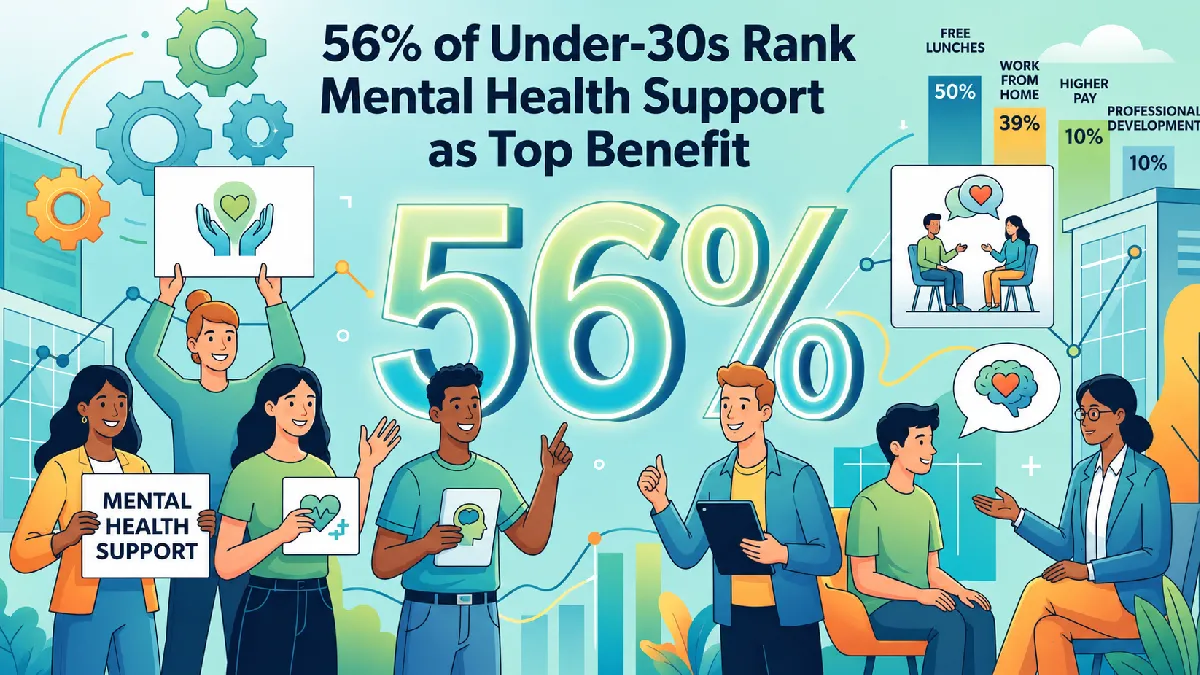
- 56% of under-30s rank mental health support as their most valued workplace health benefit, against 37% of those aged 51 to 70.
- 47% of people would factor mental health support into a decision to join or stay with an employer.
- Mental ill health is the leading cause of long-term sickness absence in the UK, contributing to 148 million lost working days last year, according to the CIPD
Generic, crisis-triggered support leaves you exposed on retention with your highest-flight-risk cohort. Prevention-first support, which identifies risk early and sits inside daily working life, is what meets the expectation.
The Generational Split in What Employees Actually Want
A Semble-commissioned survey of 1,000 UK adults found that 56% of under-30s rank mental health support as their most valued workplace health benefit, compared with 37% of those aged 51 to 70. That gap tells you where the pressure sits. Under-30s already change jobs more often than any other age group, and the same cohort now treats mental health support as a reason to stay or go.
The retention stakes are explicit in the same data. Nearly half of respondents, 47%, said they would factor mental health support into a decision to join or remain with an employer. For under-30s, that decision carries more weight because early-career workers move jobs more readily and replacing them costs money in recruitment, onboarding, and lost productivity. An employer with a weak mental health offer is exposed exactly where turnover is cheapest for the employee and most expensive for the business.
The expectation varies by region rather than attaching to a single benefit. Among respondents in London and the South, 33% called private healthcare a must-have, against 15% in Scotland. What the regional split really shows is that the demand attaches to whatever route feels most reliable in that area. In regions where private routes feel normal, the demand attaches to those routes; elsewhere it attaches to something else. What stays constant is immediacy of access, not any one package HR can bolt on and consider the problem solved.
Why Perks Aren't the Same as Support
Younger employees are not asking for a longer benefits list. They are asking for support they can reach before a problem becomes a crisis, and most current offerings are built to trigger only after one arrives.
Consider how a standard Employee Assistance Programme works in practice. An EAP sits in the background until someone reaches a breaking point, then offers a phone line and a handful of counselling sessions. That model treats mental health as an emergency service. It does nothing during the weeks and months when someone is under strain but still functioning, which is precisely when early support changes the outcome. A crisis-triggered benefit cannot meet an expectation that is really about prevention.
One-off wellbeing subscriptions miss for a different reason. A single app licence or a meditation platform handed out at onboarding gives everyone the same generic starting point regardless of what they actually need. Someone struggling with sleep, someone managing anxiety, and someone recovering from burnout all get the same undifferentiated tool. Without any way to identify who needs what, the subscription becomes another perk that most people forget they have.
Both failures share the same root, which is access. Younger employees want support embedded in the working day, not gated behind a helpline number or buried in a benefits portal they visit once. They expect to find help the way they find everything else, quickly and without a formal request.
Support that arrives too late or fits no one in particular is the wrong shape for what younger employees are asking for.
The Cost of Getting This Wrong
Mental ill health is now the leading cause of long-term sickness absence in the UK, and the CIPD ties it to 148 million lost working days in a single year. That figure puts the generational data onto the balance sheet. When your youngest employees are also the group most likely to leave over inadequate mental health support, you carry both a turnover cost and an absence cost inside the same cohort.
The absence cost compounds the retention cost rather than sitting alongside it. A worker who disengages before they resign often takes sick days first, and long-term absence carries the heaviest price of all because it triggers cover costs, lost output, and slower recovery when support arrives late. Reactive benefits do little here. By the time an employee reaches for crisis support, the absence has usually already started.
The Keep Britain Working review has put this on the national agenda, examining how employers can keep people in work and reduce the flow into long-term ill-health absence. That policy attention raises the stakes for employers who treat mental health as a discretionary line item. If regulators and the wider labour market start judging companies on how well they keep people healthy and working, an organisation running a purely reactive model will look exposed against peers who invested in early support.
Absence driven by mental ill health is expensive, largely preventable, and concentrated in the group you most want to keep.
What a Prevention-first Strategy Actually Looks Like
A prevention-first model identifies risk before it becomes absence, which is the opposite of a reactive model that only acts once an employee reaches breaking point and calls an EAP number, which means the people who most need help are often the ones least likely to pick up the phone.
A prevention-first model starts with regular check-ins that ask people how they are actually doing, using short assessments that flag stress, poor sleep, or declining mood while there is still time to act. It gives managers the training to spot early warning signs and hold a useful conversation rather than freezing or escalating too late. It puts everyday tools within reach, so someone can work on their sleep, movement, or stress in the ordinary run of a week rather than at the point of collapse.
For younger employees, what matters is access and timing. A benefit gated behind a crisis threshold reads as something the employer hopes you never use. A benefit built into daily working life reads as something the employer expects you to use and wants to make easy. That second version is what the survey data describes when under-30s rank mental health support above every other health benefit.
Champion Health builds its platform around this prevention-first logic. On our platform, employees complete a health assessment that surfaces risk early, then get personalised support across mental health, sleep, movement, and nutrition, while HR teams see anonymised, aggregated data on where risk is concentrated. Employers gain by acting on what that data shows before it turns into long-term sickness absence, rather than adding another number to a benefits menu.
The Benefits-strategy Takeaway for HR Directors
Treat your next benefits review as a retention decision, not a wellbeing line item. The data points to one exposure. Under-30s value mental health support more than any other age group and move jobs more readily than any other age group, and an employer offering only generic or crisis-triggered support is weakest with exactly that cohort. Losing that cohort costs you rehiring, retraining, and lost institutional knowledge, and it happens faster than with any other age band.
A bigger benefits menu will not fix this. Adding another subscription to a reactive model still leaves the same gap your youngest employees are telling you about. What changes retention is support that identifies risk early and sits inside daily working life, so people use it before a problem becomes a sickness absence.
At Champion Health, we build around that prevention-first approach: employees complete an assessment that flags risk early, and support becomes part of the working day rather than a phone number people call in crisis. Book a demo to see where your own workforce data shows risk concentrating.
Meeting the expectation means moving support upstream, so it reaches employees before they are struggling rather than only after.
FAQs
Why do younger employees value mental health support more than older employees?
A Semble-commissioned survey of 1,000 UK adults found 56% of under-30s rank mental health support as their most valued workplace health benefit, against 37% of those aged 51 to 70. Under-30s also change jobs more often than any other age group, which raises the retention stakes attached to the benefit.
Does mental health support actually affect whether people stay in a job?
Yes. 47% of respondents in the same survey said access to mental health support would factor into a decision to join or remain with an employer, according to Entrepreneur UK's coverage of the research.
Is an Employee Assistance Programme (EAP) enough on its own?
An EAP is built to respond once someone reaches a crisis point, typically through a phone line and a set number of counselling sessions. It does not cover the period before that, when early, proactive support has the most effect, so most HR Directors pair it with a prevention-first layer rather than relying on it alone.
What does a prevention-first mental health strategy involve?
It combines regular check-ins or short assessments that flag risk early, manager training to spot warning signs, and everyday tools employees can use before a problem becomes a crisis, rather than support that only activates after someone is already struggling.
Citations
- Cullen, P. (2026). Mental health support tops workplace benefits for over half of under-30s. Entrepreneur UK. Semble-commissioned survey of 1,000 UK adults; regional and generational benefit-preference statistics.
- CIPD (2025). Health and wellbeing at work 2025. Mental ill health as the leading cause of long-term sickness absence.
- Royal Society for Public Health (2026). 148 million working days lost to ill health as sickness absence stalls.
- Department for Work and Pensions (2026). Keep Britain Working Review: Final report.
