

8 Effective Workplace Adjustments for Managing Neurodivergent Employees
According to the City & Guilds Neurodiversity Index 2025, 1 in 3 neurodivergent employees are not satisfied with the support they receive at work, and 37% of managers say they have had no training on neurodiversity at all.
That combination is a problem. Managers who want to do right by their neurodivergent colleagues often simply do not know where to start. And without practical guidance, good intentions stay intentions.
The thing is, most of the adjustments that make the biggest difference for managing neurodivergent employees are not expensive, complicated, or time-consuming. They are mostly about flexibility, clarity, and paying attention to what individual people actually need. This article covers eight that work.
Why Are Workplace Adjustments Important for Managing Neurodivergent Employees?
Because without them, you are asking people to perform at their best in an environment that was not built for how they work. And that gap costs everyone.
When supporting neurodivergent employees is done well, the benefits show up across the board: stronger engagement, reduced absence, better retention, and in many cases, measurable improvements in output quality.
TheCIPD Neuroinclusion at Work Report 2024 found that neurodivergent employees are significantly more likely to feel exhausted (45% vs 30% of neurotypical colleagues), pressured (35% vs 29%), and lonely at work (23% vs 17%). Those numbers do not stay abstract. They become burnout, sick days, and resignations.
The adjustments in this article are not extraordinary accommodations. Most of them cost nothing. Many of them improve the working environment for everyone. And all of them start with a simple premise: helping neurodivergent employees succeed is good management, full stop.
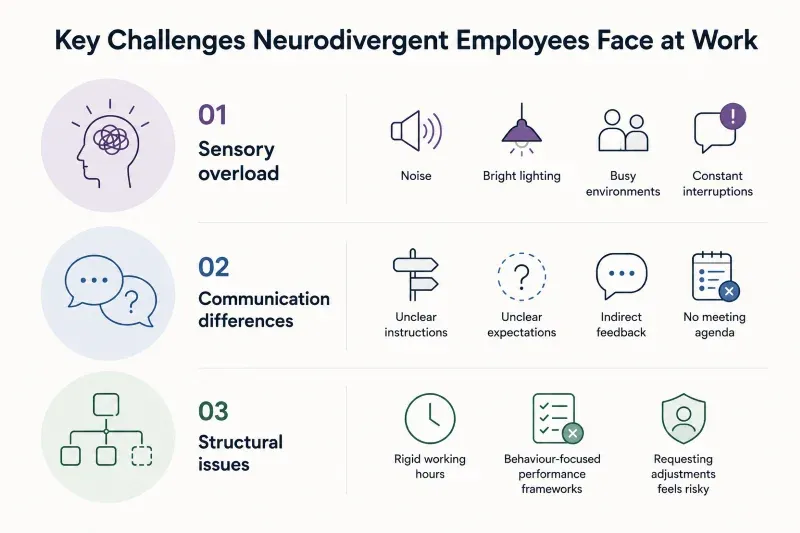
What Are the Key Challenges Neurodivergent Employees Face at Work?
The challenges vary by person and condition, but a few patterns come up consistently:
- Sensory overload – Open-plan offices, noisy environments, bright fluorescent lighting, and constant interruptions can be genuinely debilitating for employees with autism or ADHD. This isn’t a minor inconvenience but a real barrier to productivity.
- Communication differences – Ambiguous verbal instructions, unclear expectations, indirect feedback, or meetings without agendas create confusion for many neurodivergent employees that neurotypical colleagues may never notice.
- Structural issues – Rigid working hours that clash with how someone’s brain works best, performance frameworks focused on behaviours rather than outcomes, and workplace cultures where requesting adjustments feels risky. Only 31% of neurodivergent employees have not disclosed their condition to their manager or HR (CIPD, 2024), mainly due to stigma and fear of being treated differently.
Managing a neurodivergent employee well means understanding these barriers, not as individual quirks to manage around, but as legitimate responses to environments that need to change.
8 Effective Adjustments for Supporting Neurodivergent Employees
1. Flexible Working Hours
For many neurodivergent employees, a rigid 9-to-5 schedule conflicts with when they naturally think and function best. Some people with ADHD do their sharpest work in the early morning or late evening. Others need a slower start to regulate before they can engage effectively.
Allowing flexibility around start and finish times, where the role genuinely allows it, removes a significant source of daily stress. So does building in buffer time before or after demanding tasks. This does not mean abandoning structure. It means finding the structure that actually works for the person.

2. Quiet or Low-Stimulation Workspaces
Open-plan offices are particularly difficult for employees who are sensitive to sensory input. Noise, movement, and unpredictable sounds can make sustained concentration nearly impossible for some people on the autism spectrum or with ADHD.
Practical options include designated quiet zones, access to private meeting rooms for focused work, or simply normalising the use of noise-cancelling headphones. For hybrid or remote teams, protecting certain days for home working can serve the same purpose.
- Note for managers: You do not need to redesign the office. Even a clear agreement that someone can work from a quiet room on certain days can make a significant difference.
3. Clear Instructions and Structured Workflows
Ambiguity is stressful for most people. For many neurodivergent employees, it is genuinely destabilising. Vague briefs, shifting priorities, and verbal instructions that change between the meeting and the deadline create anxiety that gets in the way of the work itself.
When managing neurodivergent employees, default to written communication for tasks and expectations. Use checklists for recurring processes. Make deadlines explicit. Keep project briefs concise and specific. These habits are good management practice regardless of who is on your team.
4. Visual and Digital Tools for Task Management
Many neurodivergent employees, particularly those with ADHD or dyslexia, benefit significantly from visual task management tools. Seeing the full picture of a project laid out in a Kanban board or organised into clear stages reduces cognitive load and makes priorities easier to track.
Tools like Trello, Asana, or Notion are widely used and easy to set up. The goal is not to impose a system but to offer one. Ask what works for the individual.
5. Mentoring and Peer Support
One of the more underused approaches to supporting neurodivergent employees is structured mentoring. A trained mentor or peer supporter, someone who understands neurodivergent ways of working and can provide a consistent point of contact, can reduce the isolation that many neurodivergent employees quietly experience.
This does not need to be a formal programme. It can start with intentional pairing, regular informal check-ins, and making sure the person has someone to go to with questions that feel too small or too personal for a line manager conversation.
6. Sensory-Friendly Policies
Beyond quiet spaces, there are broader environmental adjustments worth considering. Lighting is a common one: fluorescent strip lights can cause genuine discomfort for some employees, and access to natural or adjustable lighting makes a real difference.
Other areas to look at:
- Temperature flexibility, particularly for employees with sensory processing differences
- Fragrance-free policies in shared spaces
- Adjustable desk setups for employees who regulate better when they can move
- Permission to wear noise-cancelling headphones during focused work without it being seen as rude or antisocial
Most of these cost nothing and signal that the organisation is paying attention.
7. Personalised Communication Approaches
There is no single right way to communicate with a neurodivergent employee, which is exactly the point. How to manage a neurodivergent employee well often comes down to asking, early and openly, how they prefer to receive feedback, how they like to be briefed, and what kind of meeting format works best for them.
Some people work better with written agendas sent in advance. Some find verbal feedback in group settings difficult but respond well to written notes afterwards. Some need explicit confirmation of what they have heard rather than assumed understanding.
- Tip: Ask in the first week, not after a problem has already developed. “How do you work best?” is a genuinely useful question for any new team member.

8. Regular Check-Ins and Feedback Loops
Infrequent, high-stakes reviews are hard for most employees. For many neurodivergent employees, the combination of irregular feedback and unclear expectations is particularly anxiety-inducing.
Short, frequent check-ins, even 15 minutes once a week, give neurodivergent employees a reliable opportunity to raise questions, flag if something is not working, and get specific feedback while tasks are still fresh. This also gives managers an early view of any difficulties before they compound.
The key is consistency. A standing meeting that gets cancelled repeatedly is worse than no standing meeting at all.
What Does Good Practice Actually Look Like? A Quick Comparison
| Without Adjustments | With Adjustments |
|---|---|
| Verbal briefings with assumed understanding | Written summaries alongside verbal instructions |
| Annual or biannual performance reviews | Short, regular structured check-ins |
| Open-plan only seating | Access to quiet zones or flexibility to work elsewhere |
| Rigid hours with no flexibility | Agreed flexibility around start times or focus blocks |
| Generic onboarding for all new starters | Explicit written expectations and structured introductions |
| Adjustments only available after formal disclosure | Default inclusive practices available to everyone |
Making Workplace Adjustments Stick When Managing Neurodivergent Employees
The eight adjustments in this article work. The harder part is making them consistent.
A common pattern is that organisations make the right moves at onboarding, pair the new employee with a mentor, agree on some flexibility, send written briefs, and then quietly slip back into default habits over the following months. The open-plan pressure returns. The written notes stop. The check-ins get cancelled. Six months in, the person is struggling again and nobody quite knows why.
Helping neurodivergent employees succeed long-term is not a one-off exercise. It requires managers who check in regularly, HR teams who review whether adjustments are still working, and a culture that makes it easy to raise a concern without it feeling like a formal complaint.
The good news is that organisations doing this well consistently report that the benefits extend well beyond their neurodivergent employees. Clearer communication, more flexible processes, and more deliberate management practices tend to improve things for everyone. This is what neuroinclusion done properly actually looks like.
Want to Understand Where Your Workforce’s Wellbeing Needs Attention?
Champion Health helps organisations identify workforce risk before it becomes burnout, absence, or turnover, with anonymous health assessments and data-led insights across mental health, physical wellbeing, and more.Book a demo to see how it works.
Frequently Asked Questions
What are the most common mistakes managers make when supporting neurodivergent staff?
The most common one is waiting for a problem to surface before doing anything. Many managers also default to the same approach for everyone on their team, rather than asking what the individual actually needs. A third pattern is treating adjustments as a one-time conversation rather than something to revisit as the role or context evolves.
How can small businesses implement these adjustments cost-effectively?
Most of the adjustments in this article cost nothing. Written instructions, flexible hours, regular check-ins, and clearer communication require time and intention, not budget. For sensory adjustments like noise-cancelling headphones or adjustable lighting, the cost is low relative to the impact on productivity and retention.
How do flexible schedules impact team collaboration and deadlines?
With clear agreements in place, they rarely cause problems. The key is distinguishing between when someone is online or present and when work is due. Flexibility around hours does not need to mean flexibility around deadlines. Most teams find that being explicit about core overlap hours and using shared tools for visibility is enough to manage the practicalities.
What tools can support neurodivergent employees in daily tasks?
Task management tools like Trello, Asana, and Notion are widely used and genuinely helpful for employees who benefit from visual structure. For communication, tools that allow async responses, such as written channels rather than live calls, give people more time to process and respond. Text-to-speech and speech-to-text tools can also make a real difference for employees with dyslexia.
How often should managers check in with neurodivergent employees?
Weekly short check-ins tend to work well as a starting point, with the frequency adjusted based on what the individual finds useful. The format matters as much as the frequency: a structured agenda, even a simple one, makes check-ins more useful than open-ended “how are you” conversations that many neurodivergent employees find difficult to navigate.