
Executive Summary
- UK workers lost 185.6 million working days to sickness in 2022, and industry research suggests the average has since risen to around 9.4 sick days per employee.
- Presenteeism costs UK employers around £45 billion a year, roughly 1.5 times the cost of absence, yet it never appears in a single absence record.
- Absence management software records Bradford Factor scores, SSP, fit notes, and return-to-work workflows accurately, but every tool in the category measures absence only after the first sick day.
- Mental health and MSK drive the longest absences, and both build gradually, which makes them identifiable before they escalate.
- Champion Health sits upstream of your absence tool, finding where risk concentrates at cohort level, and delivering self-management content before absence occurs.
Why Absence Management Software Solves the Wrong Problem First
UK workers lost 185.6 million working days to sickness or injury in 2022. Industry research suggests the average has since risen to around 9.4 sick days per worker per year, up from 5.8 before the pandemic, though the ONS national average sits lower. Absence management software captures every one of those days after the fact. It logs the absence, scores it, and files the fit note. What it cannot do is tell you why the absence happened.
The larger cost never reaches the dashboard. Presenteeism is the productivity lost when people work while unwell. It costs UK employers an estimated £45 billion a year, roughly 1.5 times the cost of absenteeism. An employee grinding through a bad week of anxiety or back pain produces a fraction of their usual output, yet the absence system records no event. The most expensive part of your workforce health problem leaves no data trail in the tool built to manage it.
Mental health and musculoskeletal conditions make this gap worse because they drive the longest and most recurrent absences. Work-related stress, depression, and anxiety accounted for 54% of all working days lost to ill health in 2022/23. MSK disorders add another 7.8 million days a year. Neither condition arrives overnight. Mental health absence builds through sustained stress and lack of support, and MSK risk shows up as early discomfort long before anyone reaches physiotherapy or occupational health.
That gradual build is what makes both conditions preventable. If the risk is measurable weeks before the first sick day, a tool that only starts counting once someone calls in sick is solving the wrong problem. It manages the outcome and ignores the cause. Employers who reduce absence do it upstream, by finding where risk is concentrating before it turns into a logged day off.
What Absence Management Software Actually Does
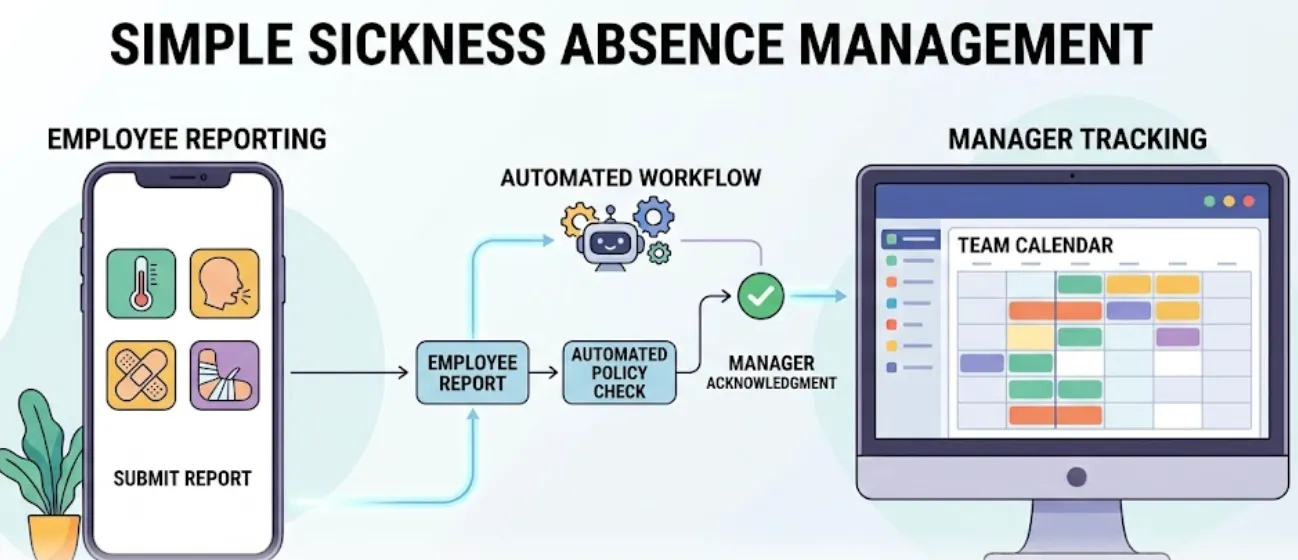
Absence management software automates the record-keeping and compliance work that HR teams used to do by hand. The core feature set is consistent across vendors. Bradford Factor scoring, fit note tracking, return-to-work workflows, SSP compliance, and reporting.
The Bradford Factor sits at the centre of most systems. It scores absence using the formula S² × D, where S is the number of separate absence spells and D is the total days lost, calculated over a rolling 12-month window. The maths deliberately weights frequent short absences more heavily than one long spell. Five one-day absences (25 × 5 = 125) score far higher than a single five-day absence (1 × 5 = 5). Systems auto-calculate the score on every absence event and let you set trigger thresholds. Sense HR cites typical triggers of 200 for a first warning and 400 for formal action, with alerts firing to the line manager and HR when scores cross a threshold.
Fit note tracking handles the paperwork around longer absences. You upload the GP fit note against the employee record, and the system tracks expiry dates and flags notes for review before they lapse. Return-to-work workflows automate the meeting that should follow every sickness absence, booking the interview on return with templates and multi-party sign-off from employee, manager, and admin.
Under the Employment Rights Act 2025, SSP becomes payable from day one of sickness from 6 April 2026. The three-day waiting period and the lower earnings limit are both abolished, extending eligibility to part-time and lower-paid staff who previously did not qualify. Your software will need to log sickness in real time from day one and feed clean data to payroll, or you risk underpayment penalties under the new Fair Work Agency. Short absences are expected to rise once the financial disincentive disappears, putting more pressure on Bradford Factor tracking.
Reporting rounds out the set. Absence rates broken down by team, location, and manager, plus year-on-year comparison and cost-of-absence figures.
Every tool in this category shares the same ceiling. Each one measures absence after it has been recorded. The Bradford Factor cannot score a health risk that has not yet produced a sick day, and a fit note only exists once someone is already too unwell to work. None of these tools measures the mental health or musculoskeletal risk building in your workforce before the first absence is logged.
The Presenteeism Gap: What Absence Data Cannot See
Presenteeism is the productivity lost when employees work while unwell, and it costs UK employers roughly £45 billion a year, about 1.5 times the cost of absenteeism, yet none of it appears in an absence report. Employees who work through illness, stress, or musculoskeletal pain still clock in. From a dashboard’s perspective, nothing has happened, even though their output has dropped and their condition is quietly getting worse.
Absence software cannot capture this. The Bradford Factor, fit note tracking, and return-to-work workflows all depend on a recorded event. An employee has to be absent for the system to register anything. Presenteeism produces no event, so the tool that scores highest on compliance can still leave you blind to the larger share of your workforce health cost.
The CIPD has found that presenteeism costs more in lost productivity than sickness absence itself. Someone working while unwell recovers more slowly, makes more mistakes, and faces a higher risk of developing a chronic condition. Presenteeism often precedes the recorded absence rather than replacing it. A pattern of working through untreated stress or back pain builds toward the eventual sick day your software finally logs, by which point the cheapest window to intervene has already closed.
A platform can automate Bradford Factor triggers flawlessly and still tell you nothing about the mental health and MSK risk building across your teams right now. Days lost is a lagging indicator. It confirms risk has already turned into cost.
Detecting presenteeism means looking for signals the software was never built to see. Declining output, reduced focus, more frequent errors. These are the markers managers are trained to spot, but observation does not scale across a workforce of several hundred. Closing the gap requires measuring health risk directly at population level, not inferring it after absence has been recorded.
The UK Absence Management Software Market: An Honest Comparison
The entries below assess each platform on what it actually does, where the evidence is strong, and where it stops. Some vendors publish detailed case studies. Others share little beyond category positioning. The entries reflect that difference rather than filling gaps with assumptions.
Each profile pairs with the comparison table further down. The absence-focused platforms score well on Bradford Factor tracking, SSP compliance, and return-to-work workflows, but every one of them measures absence after it is recorded. Champion Health sits upstream of the first sick day and appears here as a prevention layer, not a like-for-like alternative.
Champion Health
Champion Health sits upstream of your absence tool. Your absence software tells you who was off and for how long. Champion Health tells you where health risk is building before anyone books a sick day. Mental health and musculoskeletal problems, the two conditions driving the longest UK absences, both develop gradually rather than appearing overnight.
The platform tracks five signals with the strongest predictive relationship to future absence. Mental health risk shows up as stress, anxiety, and low mood building well before an employee ever reaches for an EAP. MSK risk appears as early discomfort and pain long before someone needs physiotherapy or an occupational health referral. Sleep quality acts as a leading indicator of both mental health deterioration and MSK flare-ups. Presenteeism, where health is already dragging on performance, is measured directly rather than inferred after the fact. Cohort variation flags where risk concentrates in specific teams, functions, or locations.
That last signal solves a problem most reporting hides. An organisation-wide absence rate of 3% sounds healthy, but it can mask one team sitting at 1% and another at 12%. Workforce health risk clusters in cohorts rather than spreading evenly, so headline averages conceal where the real problem lives. Champion Health surfaces that variation so you can act on the 12% team instead of being reassured by the 3% average.
The platform works through three stages. First, it identifies where risk is building at cohort level through the Workforce Health Risk Assessment, complete with financial impact modelling and executive-ready reporting. Second, it prevents at scale by delivering mental health and MSK self-management content to the cohorts showing early risk, changing behaviour before conditions escalate. Third, it escalates when required by routing employees into the support you already pay for. Someone showing clinical-level mental health risk reaches your EAP. Someone with worsening MSK signals reaches physiotherapy or occupational health. The Faculty of Occupational Medicine finds that early occupational health referral reduces both the duration and recurrence of absence, so getting the right person to the right service at the right time carries real financial weight.
Champion Health does not replace your absence management software, and it is not meant to. Bradford Factor scoring, statutory sick pay compliance, fit note tracking, and return-to-work workflows all belong in a dedicated absence tool built for that job. Champion Health does not calculate S² × D triggers or manage SSP payments. We add the layer those tools have never covered by explaining why absence is happening and giving you a mechanism to reduce it before it appears in the records your absence software captures.
The practical outcome is that your existing absence investment works harder. Instead of only recording events, you gain the ability to prevent a share of them, and you can point resources at the cohorts where prevention will move the numbers most.
Best for: Mid-size UK employers who already have an absence tool and want to understand why absence is happening and reduce it before it occurs. Start with the Workforce Health Risk Assessment to see where risk is building across your workforce.
e-days
e-days is a strong pure-play absence and compliance platform for mid-market UK employers. It runs across more than 1,400 organisations in 120 countries and supports 25 languages, which matters if your finance or professional services firm operates across multiple sites or jurisdictions. Pricing starts from around £2 per employee per month, and the platform holds ISO 27001 certification. For an HR team that wants clean absence recording without stitching together spreadsheets and paper forms, it does the core job properly.
Bradford Factor automation is where e-days earns its reputation. It calculates the S² × D score on every absence event over a rolling 12-month window, applies your configurable trigger thresholds, and alerts the line manager and HR automatically when a score escalates. You set the numbers, and the platform enforces them consistently across every team, which removes the inconsistency that undermines most manual attendance policies.
Its day-one SSP readiness for April 2026 makes e-days worth a serious look this year. From 6 April 2026, statutory sick pay becomes payable from the first day of sickness. The three-day waiting period disappears and the lower earnings limit is removed, so part-time and lower-paid staff who never qualified before now do. e-days logs sickness in real time from day one and feeds it directly to payroll, which is what keeps you compliant under the new Fair Work Agency and out of underpayment penalties. Short one-to-three day absences are expected to rise once the financial disincentive goes, and that puts more load on Bradford Factor tracking, exactly where the platform performs.
e-days measures absence after it is recorded, and nothing in the product tells you why the absence happened or how to prevent the next one. The platform offers no presenteeism measurement and no mental health or musculoskeletal prevention content, so an employer running e-days alone still sees only the days already lost. It answers what happened, not where risk is building.
GoodShape
GoodShape captures why people are off, not just that they are, which gives an HR team more to learn from the data. Its dynamic data capture logs specific absence reasons like musculoskeletal problems, stress and anxiety, and respiratory illness rather than filing everything under a generic sickness label. Layered on top sits the GoodShapeIndex, described as the UK’s largest workplace health database with over 23 million absence events recorded, which lets you benchmark your absence patterns against industry and national comparators.
The analytics run deeper than most tools in the category. GoodShape offers 60 or more customisable reports across weekly, monthly, quarterly, and annual views, plus predictive analytics that flag employees at risk of long-term or frequently recurring absence before those patterns fully play out. A Watford Borough Council case study reports a 44% absence reduction alongside improved return-to-work compliance and better line-manager policy tracking. GoodShape also adds clinical depth that pure absence tools lack, including 24/7 telehealth appointments, absence assessments from clinical professionals, and tracked referrals to occupational health.
GoodShape gives strong absence-reason intelligence, telling you which conditions drive your lost days and which teams carry the heaviest burden. But that intelligence has a clear limit.
The limit is where that intelligence points. GoodShape’s reason analytics and predictive flagging still operate on absence events, which means the signal only fires once someone has already booked off sick or crossed a recurrence threshold. Knowing that stress and anxiety cause a large share of your absence is useful, but it does not tell you which employees are struggling now, before their first sick day. The daily care plans and 140-topic advice library support people once an absence episode is open, and no structured mental health or musculoskeletal behaviour-change programme is described that would reduce the underlying risk across a workforce. Presenteeism goes unmeasured, so the productivity lost while people work through poor health stays invisible. GoodShape answers what happened and why with real precision. It does not answer where risk is building before absence occurs.
YuLife
YuLife sits in a different part of the market from a pure absence platform. It combines group life, income protection, and health insurance with a wellbeing app that rewards daily movement, mindfulness, and other healthy behaviours through in-app currency. The available public sources do not describe YuLife’s absence tracking, Bradford Factor scoring, or SSP compliance features, so any claim about its performance on those criteria would be speculation rather than fact.
What the insurance-linked model does well is engagement. Gamified rewards give employees a reason to open the app and repeat small behaviours, and that engagement can support the same movement and sleep habits that reduce long-term health risk. For an employer choosing a group insurance provider, bundling a wellbeing app into the policy is a reasonable way to add value without a separate procurement.
The gap for absence reduction is analytical, because rewarding individual behaviour is not the same as identifying where mental health or musculoskeletal risk is building across a specific team. Rewarding daily movement does not surface which cohort is heading towards absence before the first sick day. YuLife measures participation. It does not, on the evidence available, produce cohort-level risk analytics or feed a return-to-work workflow.
Treat YuLife as an insurance and engagement layer rather than an absence or prevention analytics tool. It can raise participation in healthy behaviours, but it will not replace a dedicated absence platform for compliance, nor a prevention layer for root-cause risk identification.
PAM Wellness
PAM Wellness comes from an occupational health and employee assistance background, which shapes what it does best and where it stops. The available public sources do not detail PAM’s absence software features, pricing, or capability comparisons, so this entry stays deliberately narrow. Treat any specific feature claim about PAM as something to verify directly with the vendor rather than something these sources can confirm.
What the occupational health and EAP lineage tells you is the shape of the offer. Occupational health services support employees who are already unwell or already absent, through clinical assessment, fitness-for-work advice, and referral. An EAP gives staff a route to counselling and practical support when they reach for it. Both matter, and both are reactive by design. They respond once an employee is struggling enough to seek help or is flagged through an absence event.
Timing is what matters for a prevention-first buyer. Clinical support answers what an employer should do once someone is unwell. It does not tell you where mental health or musculoskeletal risk is building across a cohort before anyone books an appointment or logs a sick day. A team of 200 can carry rising strain that no occupational health referral will surface until individuals cross a threshold and present themselves.
If you already run PAM for occupational health or EAP provision, keep it for the clinical and support work it does well. Pair it with upstream risk analytics that identify where prevention effort should go first, rather than waiting for referrals to arrive.
Health Assured
Health Assured built its reputation on employee assistance programmes and telephone counselling, giving staff a route to confidential support when they are already struggling. That lineage matters because a good EAP can shorten the length of an absence episode and give an employee somewhere to turn during a mental health crisis. Access to support is a real benefit, and Health Assured has scale in delivering it.
The available public sources do not contain named feature detail, pricing, or independent capability comparisons for Health Assured, so this entry stays deliberately narrow. Its category position separates access-to-support from cohort-level risk identification. An EAP responds when an individual reaches out. It does not tell you which teams are carrying rising mental health or musculoskeletal risk before anyone books a counselling session.
This difference decides where Health Assured fits in your stack. An EAP is a valuable safety net for people already in difficulty, and most mid-size employers should have one. It sits alongside your absence tool rather than replacing it, because it neither scores Bradford Factor triggers nor identifies where risk is building across your workforce. Treat it as reactive support, and pair it with an upstream layer that spots the pattern before an employee needs the phone line.
Side-by-Side Comparison: Absence Management and Prevention Capability
The table below scores each platform across six capabilities, from core compliance features to upstream prevention. Read it as a map of where each tool stops, not a single winner, because compliance tools and prevention layers answer different questions.
| Capability | e-days | GoodShape | YuLife | PAM Wellness | Health Assured | Champion Health |
|---|---|---|---|---|---|---|
| Bradford Factor tracking | ✓ | ✓ | — | — | — | — |
| SSP / fit note compliance | ✓ | ✓ | — | Partial | — | — |
| Return-to-work workflows | ✓ | ✓ | — | ✓ | Partial | — |
| Presenteeism measurement | — | — | — | — | — | ✓ |
| Root-cause risk analytics | — | Partial | — | — | — | ✓ |
| MH / MSK prevention content | — | Partial | Partial | Partial | Partial | ✓ |
e-days and GoodShape own the left three columns, where compliance and workflow live. Champion Health owns the right three, where risk is measured before it becomes absence. No single tool covers both ends, which is the point of running an absence platform and a prevention layer together.
From Reactive Tracking to Prevention-First Workforce Health Intelligence
A Bradford Factor score tells you an employee has hit a trigger threshold. By then the absence has already occurred and the health problem behind it has already escalated. Mental health and MSK conditions, the two drivers of the longest UK absences, build over weeks or months of sustained stress or early discomfort. That build is catchable before the first sick day. Absence records miss it entirely.
An organisation with a 3% overall absence rate sounds healthy, but that headline can hide one team at 1% and another at 12%. Workforce health risk clusters in specific teams, functions, locations, and demographics, so an organisation-wide figure actively conceals the cohort that needs attention. Absence software reports the average because that is the data it holds. It cannot tell you which team is deteriorating, only which individuals have already crossed a threshold.
Five signals carry the strongest predictive relationship to future absence, and none appear in an absence dashboard. Mental health strain builds before anyone reaches an EAP. MSK discomfort shows up before it becomes a physiotherapy referral. Poor sleep quality precedes both mental health decline and MSK flares. Productivity impairment shows that health is already affecting performance while the employee stays at their desk. Cohort variation reveals structural drivers that no headline rate exposes. Measure these and you can intervene while intervention still changes the outcome.
The practical recommendation is to run both layers. Keep your absence tool for Bradford Factor workflows, SSP, fit note tracking, and return-to-work processes. Those are compliance functions, and a dedicated platform handles them properly. Add a prevention layer to identify where risk is building at cohort level, deliver self-management support before conditions escalate, and route employees into your existing EAP, occupational health, and physiotherapy services when needed. Your absence software records what happened. A prevention layer reduces how much of it happens.
How We Chose These Tools
We scored each tool against four criteria that matter to a UK employer running absence at scale.
UK compliance capability came first. We looked at Bradford Factor scoring with configurable triggers, fit note tracking, return-to-work workflows, and readiness for the April 2026 SSP change that pays sick pay from day one and removes the lower earnings limit.
Integration depth came second. A tool that pushes SSP figures straight to payroll and connects to your HRIS saves manual reconciliation and reduces the risk of underpayment penalties under the new Fair Work Agency.
Presenteeism and prevention capability came third. We assessed whether a tool identifies health risk building across cohorts, measures presenteeism, and delivers mental health or musculoskeletal content that changes behaviour before absence occurs.
Quality of public evidence came fourth. We weighted case studies with measurable results, such as Watford Borough Council’s reported 44% absence reduction with GoodShape, alongside third-party reviews on G2 and Capterra.
Public information for YuLife, PAM Wellness, and Health Assured was limited in the sources we reviewed, so those entries carry more caution than e-days or GoodShape do. Where a vendor published no independent evidence for a claim, we said so rather than assume the capability exists.
Frequently Asked Questions
What is the Bradford Factor and how do UK employers use it? The Bradford Factor scores absence using the formula S² × D, where S is the number of separate absence spells and D is the total days absent over a rolling 12-month window. It weights frequent short absences more heavily than single long ones, so five one-day absences score far higher than one five-day absence. Most UK employers set trigger thresholds, often around 200 for an informal conversation and 400 for formal action, to prompt manager review.
How does the April 2026 SSP change affect absence software requirements? From 6 April 2026, statutory sick pay becomes payable from day one, and both the three-day waiting period and the lower earnings limit are removed. Employees who previously did not qualify now do, which means your software must log sickness in real time from the first day and pass clean data to payroll. Short one-to-three day absences are expected to rise, putting more strain on Bradford Factor tracking.
What is the difference between absence management and workforce health prevention? Absence management records and manages absence after it happens, covering Bradford Factor scoring, SSP, and return-to-work workflows. Workforce health prevention identifies the mental health and MSK risk building before anyone books a sick day. One answers what happened, the other answers where risk is concentrating.
How do you measure presenteeism? Presenteeism leaves no absence record, so managers traditionally spot it through behavioural signs like declining output, reduced focus, and increased errors. Champion Health measures it directly through self-reported productivity impairment within a broader health risk assessment, so you gain a signal that manager observation cannot capture at scale.
Does Champion Health replace absence management software? No. Champion Health sits upstream of your absence tool and identifies root-cause risk before it becomes absence. Bradford Factor tracking, SSP compliance, and fit note workflows still belong in a dedicated absence platform.