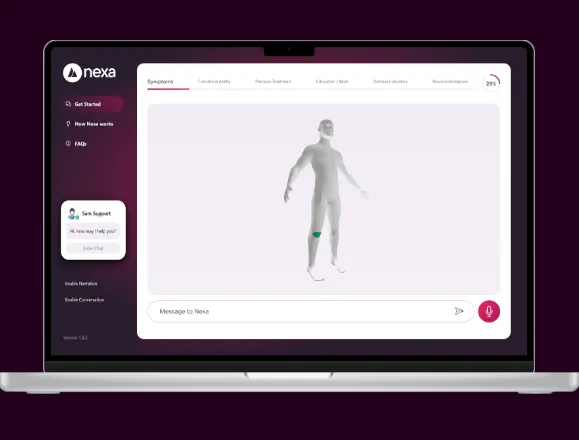
What Is Digital MSK Triage?
Digital MSK triage platforms assess musculoskeletal symptoms through online questionnaires and clinical algorithms to route users to appropriate care pathways — whether self-managed programs, virtual physiotherapy, or face-to-face treatment. This replaces traditional telephonic triage, where qualified physiotherapists conduct assessments over the phone during limited business hours.
UK employers and insurers face mounting costs. [Musculoskeletal disorders account for 26.5 million working days lost annually](https://www.hse.gov.uk/statistics/causdis/musculoskeletal.htm), making MSK the leading cause of workplace absence. Traditional triage creates bottlenecks — employees wait for callback appointments, physiotherapists handle routine assessments that algorithms can manage, and costs accumulate without proportional outcomes.
Digital triage eliminates these friction points. Users complete symptom assessments in under 10 minutes, receive immediate care recommendations, and access support 24/7 without GP or occupational health referrals. The technology screens for clinical red flags while routing straightforward cases to appropriate self-care or virtual treatment options.
Occupational health providers and insurers see faster intervention, reduced administrative overhead, and better insights into workforce MSK patterns. Organizations now need to choose which platform delivers the clinical governance and commercial functionality they require.
Why OH Providers and Insurers Are Adopting It Now
NHS community MSK waiting lists exceeded 388,000 in August 2025, creating sustained demand for private alternatives. Employees can’t wait 18-24 weeks for a physiotherapy assessment when back pain is affecting their work today. OH providers and insurers are stepping into this gap, but they need tools that scale beyond traditional telephonic triage.
Insurers are shifting from passive claims payers to active health partners. Early intervention through digital MSK triage reduces claim costs and improves member satisfaction. [Royal London and General Reinsurance](https://trackactiveme.com/) already integrate digital MSK platforms to manage group disability risks and workplace health outcomes.
Traditional telephonic triage creates operational bottlenecks. OH providers need dedicated staff, scheduled appointments, and higher per-case costs. Digital triage eliminates these constraints with 24/7 availability and automated clinical algorithms. The overhead savings alone justify adoption — before considering the improved patient flow and clinical outcomes.
Three forces have converged simultaneously: remote work has driven a measurable rise in MSK complaints, NHS capacity has hit a ceiling, and digital health adoption accelerated sharply post-pandemic. For OH providers, offering digital MSK triage is increasingly a contract requirement, not a differentiator. For insurers, the alternative is absorbing higher claims costs from delayed intervention.
What to Look for in a Digital MSK Triage Platform
Clinical Governance and Red Flag Detection Every MSK triage platform must screen for serious pathology. Choose platforms with automated red flag algorithms that escalate users to NHS 111, GP services, or qualified physiotherapists when clinical indicators suggest fractures, infections, or neurological compromise.
24/7 Access Without Referral Requirements The platform should allow employees to self-refer immediately when symptoms arise. Waiting for GP appointments or OH referrals defeats the purpose of early intervention. [Nexa provides instant access](https://www.championhealth.co.uk/nexa) through secure chat interfaces, capturing cases before they escalate.
Stepped Care Pathway Routing Triage is only useful if it routes to the right level of care. Look for platforms that distinguish between self-guided exercises for minor issues, virtual physiotherapy for moderate cases, and face-to-face treatment for complex presentations. Platforms that deliver AI-autonomous treatment skip this routing step entirely — which matters when a user needs a physio, not an app.
GDPR Compliance and Data Aggregation Personal health data must remain confidential from employers while providing aggregated insights for decision-making. Verify the platform aggregates demographic trends, injury patterns, and treatment outcomes without exposing individual employee information.
Analytics Dashboard for Strategic Planning OH providers and insurers need visibility into MSK trends, treatment pathways, and outcomes. Essential metrics include injury demographics, recovery timelines, treatment utilisation, and absence patterns. This data drives resource allocation and prevention strategies.
Integration Capabilities The platform should integrate with existing OH management systems, HR platforms, and insurance claim processing workflows. Standalone systems create administrative overhead and data silos.
Regulatory Status Verify MHRA device registration, CQC approval, or DTAC validation where applicable. These certifications indicate clinical governance standards and regulatory compliance.
Cost Model Transparency Per-employee pricing should be compared against telephonic triage costs. Digital platforms eliminate phone queue bottlenecks and reduce overhead costs while maintaining clinical safety standards.
Platform Comparison: Digital MSK Triage Tools for OH and Insurers
Four platforms dominate the UK digital MSK triage market. Each serves different buyer priorities.
| Platform | Primary Function | Clinician Involvement | Regulatory Status | Primary Buyer | Analytics | Best For |
|---|---|---|---|---|---|---|
| Nexa (Champion Health) | Triage + routing to care pathways | Routes to qualified physiotherapists | Clinically governed | OH, insurers, employers, EAPs | Employer dashboard with demographics, injury trends, ROI tracking | Commercial buyers needing comprehensive triage-and-route with physical clinic network |
| EQL Phio Access | Conversational AI triage | Support tool for clinicians | Not specified | Insurers, PMI providers | Client reporting available | Private healthcare and PMI markets with existing clinical teams |
| TrackActive Me | Triage + self-management + rehab | UK physio network referrals | MHRA Class 1 medical device | Employers, group insurers | Real-time anonymised insights | Employers prioritizing prevention and self-management alongside triage |
| Flok Health | AI-autonomous treatment | Minimal (AI delivers treatment) | CQC-approved, Class IIa medical device | NHS, healthcare systems | Clinical outcome dashboards | Healthcare systems seeking autonomous treatment delivery (limited commercial availability) |
Nexa stands out for commercial buyers through its triage-and-route model that connects to 800+ physical locations. TrackActive Me offers stronger rehabilitation depth with proven insurer clients like Royal London. Nexa provides more focused triage routing without requiring employees to engage in lengthy self-management programs.
EQL Phio Access targets the PMI market with conversational AI but lacks the detailed employer analytics that commercial buyers demand. Flok Health, despite impressive NHS results and regulatory credentials, remains primarily healthcare-system focused rather than commercial-market ready.
Commercial buyers evaluating pure triage functionality should prioritize platforms that route users to appropriate care rather than attempting autonomous treatment delivery.
Nexa by Champion Health
Nexa delivers clinically governed MSK triage specifically designed for commercial buyers — OH providers, insurers, employers, and EAPs. Users complete a symptom assessment in under 10 minutes and receive immediate routing to self-guided care plans, virtual physiotherapy, or face-to-face treatment through Champion Health’s network of 800+ physical locations.
The platform operates 24/7 without requiring GP or OH referrals. Over 80% of users receive treatment recommendations immediately, with complex cases escalated to qualified physiotherapists through built-in clinical pathways. Red flag screening automatically identifies users requiring urgent care and routes them to appropriate NHS services.
The analytics dashboard tracks injury patterns, recovery timelines, and operational impact across your workforce. All data remains GDPR compliant — personal information never gets shared with employers, and Champion Health never sells user data to third parties.
Unlike NHS-focused platforms that prioritize AI-autonomous treatment delivery, Nexa maintains clinician involvement at every decision point while eliminating the overhead costs of traditional telephonic triage. The triage-and-route model ensures users access appropriate care levels rather than defaulting to self-management protocols that may be insufficient for workplace injuries.
EQL Phio Access
EQL’s Phio Access targets insurers and private medical insurance providers with conversational AI triage built on 3,000+ decision tree scenarios. The platform guides patients through structured MSK assessments using probabilistic modeling rather than clinician-led triage routing.
Named clients include [Medicash](https://medicash.org/), [Vita Health Group](https://vitahealthgroup.co.uk/), and Circle Health/BMI hospitals. EQL positions itself primarily within the private healthcare ecosystem rather than occupational health workflows.
The platform pairs with Phio Engage for post-triage self-managed rehabilitation programs. This creates a contained pathway from assessment to recovery within EQL’s ecosystem, though it limits integration flexibility with existing OH provider networks.
EQL emphasizes clinical evidence through published literature reviews on digital MSK triage methodologies. Their research claims superior detail compared to competitors, though actual clinical outcomes data from client implementations remains limited in public documentation.
Best fit for: Private medical insurers seeking AI-driven triage with contained rehabilitation pathways. Less suitable for OH providers requiring integration with existing clinical networks or employers needing direct employee access without insurance gatekeeping.
TrackActive Me
TrackActive Me targets employers and group disability insurers with an MHRA Class 1 medical device that combines triage with detailed self-management programs. The platform delivers a [38% reduction in MSK-related days off work](https://trackactiveme.com) and boasts insurance clients including [Royal London](https://trackactiveme.com) and [General Reinsurance Group](https://trackactiveme.com).
Unlike pure triage tools, TrackActive Me emphasizes rehabilitation depth over rapid routing decisions. The platform includes evidence-based exercise programs for 26 common MSK conditions, prevention programs like Office 5 mobility routines, and DSE workstation assessments. This makes it stronger for employers wanting complete MSK management rather than just efficient triage routing.
The platform’s broader scope includes symptom tracking, WHO activity monitoring, and partnerships with UK physiotherapy networks. For insurers, TrackActive Me offers value-added services that extend beyond initial assessment into ongoing condition management. However, buyers focused primarily on fast, clinically governed triage routing may find the self-management emphasis less aligned with traditional OH referral pathways.
TrackActive Me’s insurance market track record and regulatory compliance make it a solid choice for group disability products, though its rehabilitation-first approach differs from triage-and-route models preferred by OH providers managing high-volume caseloads.
Flok Health
Flok Health delivers AI-autonomous treatment, not triage routing. Their CQC-approved platform functions as a complete AI physiotherapy clinic where patients receive weekly video appointments with an AI physiotherapist, eliminating the need for human clinician involvement in most cases.
The platform achieved a 55% waiting list reduction in NHS trials and secured $12.5M Series A funding in June 2026. As a Class IIa medical device with CQC approval, Flok meets the UK’s highest regulatory standards for digital healthcare providers.
However, Flok’s current market focus is NHS and healthcare systems, with limited availability for commercial buyers. OH providers and insurers seeking immediate triage-and-route capabilities will find [Nexa’s clinician-guided model](https://www.championhealth.co.uk/nexa) better suited to their workflow requirements and employer integration needs.
Key Buyer Concerns Answered
Is the data safe? Yes. Digital MSK platforms must comply with GDPR for commercial deployment. [Nexa aggregates all data](https://www.championhealth.co.uk/nexa) and never shares personal information with employers — only demographic trends and injury patterns reach your analytics dashboard. Employee conversations remain confidential between the user and clinical team.
What happens with red flags? Clinical algorithms automatically screen for serious pathology and urgent care indicators during the assessment. Red flags trigger immediate escalation pathways to qualified physiotherapists, NHS 111, or GP referral depending on severity. Users never get stuck with inappropriate self-management when clinical intervention is needed.
How does it integrate with our OH system? Most platforms offer API integration with major OH providers and case management systems. The integration typically handles referral data, outcome tracking, and absence reporting. Implementation teams work with your IT department to establish secure data flows that match your existing workflows.
What does it cost versus telephonic triage? Digital triage eliminates the overhead costs of staffed phone lines while providing 24/7 availability. Traditional telephonic services create bottlenecks and require dedicated clinical staff during business hours. Digital platforms scale without proportional cost increases — one license covers unlimited employee access.
What ROI can we expect? US market data provides useful benchmarks: [Hinge Health reports 2.4x ROI](https://www.hingehealth.com) through reduced surgery rates and faster return-to-work, while [Sword Health claims 3.2x ROI](https://swordhealth.com) via decreased physical therapy utilization. UK buyers should expect similar returns through reduced absence days, fewer GP referrals, and appropriate treatment routing that prevents condition escalation.
The key metric is speed to appropriate care — digital triage routes 80%+ of users to treatment immediately rather than adding weeks to the referral chain.
Why Nexa Is Built for Commercial Buyers
Nexa routes users to appropriate care levels across 800+ physical treatment locations. Unlike AI-autonomous platforms built for NHS capacity management, Nexa maintains clinician involvement at every decision point.
The platform eliminates the bottlenecks and overhead costs of traditional telephonic triage without sacrificing clinical governance. Users complete assessments in under 10 minutes, receiving immediate pathway recommendations for self-guided care, virtual physiotherapy, or face-to-face treatment. No GP or OH referral required—employees can access the system 24/7.
Built for Commercial Oversight, Not NHS Rationing
Nexa’s analytics dashboard provides employers and insurers with aggregated demographic data, injury trend analysis, and ROI tracking capabilities that NHS-focused solutions don’t prioritize. The platform screens for occupational context and work status impact during assessment—features irrelevant to NHS capacity management but important for commercial buyers.
Red flag screening automatically escalates users to qualified physiotherapists, NHS 111, or GP services when clinical indicators warrant immediate attention. This maintains the clinical safety standards commercial buyers require while avoiding the legal liability risks of fully autonomous AI treatment.
The GDPR-compliant architecture ensures personal information never reaches employers while still surfacing the aggregated workforce insights that OH providers and insurers actually need to manage costs and plan interventions.
Frequently Asked Questions
What is MSK triage?
MSK triage is the clinical assessment and routing process that determines the most appropriate treatment pathway for musculoskeletal conditions. Digital MSK triage uses algorithms and structured questionnaires to guide users through symptom assessment. It screens for red flags and recommends care pathways from self-management to face-to-face treatment.
Is digital triage clinically safe?
Yes, when built with proper clinical governance. Platforms like Nexa use clinical algorithms developed by qualified physiotherapists to automatically screen for red flags and urgent care indicators. All assessments include escalation pathways to NHS 111, GPs, or qualified clinicians when complex presentations require human review.
Can employees self-refer?
Most digital MSK platforms allow direct employee access without GP or occupational health referral. Users can complete assessments 24/7, typically receiving care pathway recommendations within 10 minutes of completing the initial assessment.
What conditions does it cover?
Digital MSK triage covers common musculoskeletal conditions: back pain, joint problems, workplace injuries, repetitive strain injuries, and post-surgical rehabilitation. The assessment evaluates presenting symptoms, functional ability, treatment history, and work impact to determine appropriate care routing.
How quickly do users get recommendations?
Most platforms provide immediate routing recommendations upon assessment completion. [Nexa reports](https://www.championhealth.co.uk/nexa) that over 80% of users receive treatment recommendations immediately, with complex cases requiring additional clinical review within 48 hours.
Get Started with Nexa
Book a no-obligation consultation to see how Nexa transforms your MSK management approach. Champion Health’s team will demonstrate the platform, discuss your specific requirements, and provide ROI projections based on your current telephonic triage costs.
Schedule a demo at championhealth.co.uk/nexa or request a free consultation to evaluate Nexa against your existing MSK provision. Implementation typically takes 2-4 weeks with full clinical governance documentation provided.
Ready to reduce MSK-related absence costs while improving employee outcomes? Contact Champion Health today.