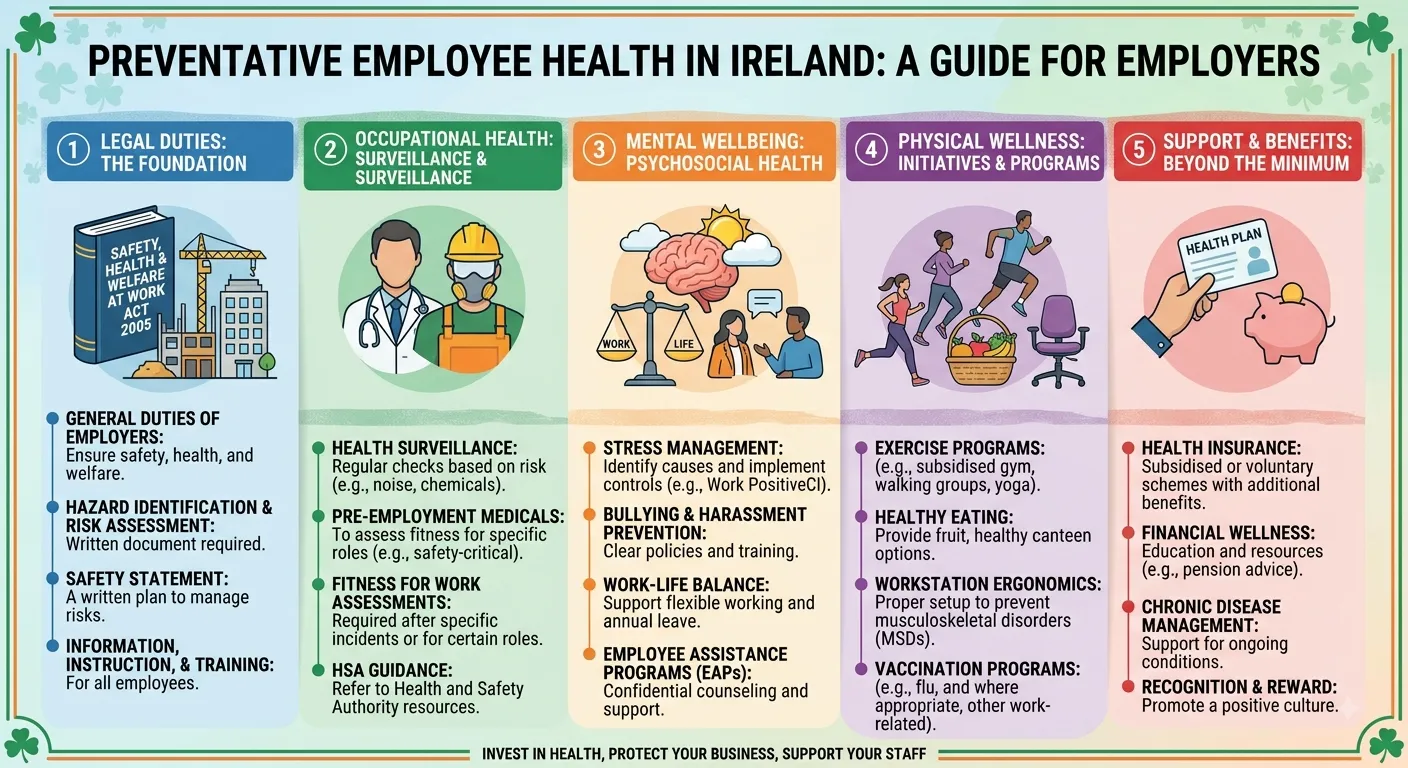

- Irish employers should evaluate wellbeing platforms by asking which workforce risks they identify before absence and how their data leads to practical action.
- Psychological harm falls within the Act’s definition of personal injury, while HSA guidance on workplace stress recognises workplace stress and other psychosocial hazards as health and safety concerns.
- Legal compliance provides a baseline, but a safety statement alone may not reveal where mental health or musculoskeletal risk is building across your workforce.
- EAP and occupational health services provide necessary support after a problem surfaces. Preventative platforms identify cohort-level risks earlier and direct employees to self-management support or existing services.
- The Safety, Health and Welfare at Work Act 2005 provides the legal starting point by requiring employers to complete workplace risk assessments and record controls in a safety statement.
The legal basis for employee health in Ireland
The Safety, Health and Welfare at Work Act 2005 sets the core duties for employers in the Republic of Ireland. Section 8 requires every employer to protect employees’ welfare by safeguarding their safety and health at work so far as is reasonably practicable. The Act’s definition of personal injury includes any work-related impairment of a person’s physical or mental condition, so the statutory duty covers psychological as well as physical harm.
Sections 19 and 20 create a clear sequence. Under Section 19, you must assess workplace hazards and consider everyone who may encounter them. Under Section 20, you must use that assessment to prepare a written safety statement that sets out the controls, responsibilities, resources, and procedures the employer uses to manage safety and health. The Act requires a current risk assessment to support the safety statement.
The statutory term “reasonably practicable” requires due care in assessing hazards and applying suitable protective measures. An employer may omit a further measure only where the effort and cost involved would be grossly disproportionate to the risk. Cost alone does not remove the duty to assess a known hazard.
The Health and Safety Authority’s workplace guidance treats workplace stress, bullying, fatigue, human factors, and remote working risks as relevant safety and health topics. Those labels come from HSA guidance and topic areas rather than a list written directly into the Act. Their legal relevance rests on the Act’s broad definitions of hazards and personal injury.
You must review the risk assessment and safety statement when workplace conditions change or when evidence suggests that the documents are no longer valid. Section 20 also requires you to bring the safety statement to employees’ attention in a suitable form and manner, and to give it to new employees when they start. Compliance guidance commonly interprets this as an annual refresh at minimum, so treat that as a working cadence rather than a fixed number written into the Act itself. Regular review and employee communication form the minimum compliance position for employee wellbeing in Ireland.
Measuring psychosocial risk
The Act makes psychosocial hazards part of an employer’s risk assessment duties, but it leaves employers to determine how those risks should be measured.
HSA workplace health and safety material covers workplace stress, bullying, human factors, and related risks. However, the available primary material does not establish a detailed assessment method that every employer can adopt. Employers must choose what to assess and set an evidence threshold for action. Workload, role clarity, management support, and exposure to bullying may require different controls.
Third-party sources need careful handling. Pelmaro and EazySAFE interpret the Act as requiring employers to include psychosocial hazards in their existing risk assessment. The Pelmaro and EazySAFE interpretation fits the Act’s broad language, but neither source establishes a specific HSA inspection mandate. EazySAFE also names WorkSafe as a validated HSA tool without linking to primary HSA documentation, so employers should verify its status before relying on that claim.
A safety statement can record general controls while revealing little about which roles or employee groups face concentrated risk. Employers therefore need evidence beyond a completed document, such as confidential workforce data that identifies patterns early enough to guide action.
Compliance requires current workforce evidence
A completed safety statement records identified hazards and controls at a point in time. Employers need current workforce evidence to detect emerging stress or musculoskeletal discomfort across roles and locations.
CSO absence figures for the second quarter of 2023 illustrate the limits of absence data. In the second quarter of 2023, 7.3% of employed people were absent during the reference week. The absence rate was 2.5% in agriculture, forestry, and fishing and 15.4% in education. However, the CSO measure combines sickness absence with other leave, including holidays and maternity leave. An employer may therefore know how many people are absent without knowing which health risks contributed or where earlier action could help.
Ireland’s statutory sick pay scheme provides five certified days per calendar year at 70% of normal daily earnings, capped at €110 per day. After employees exhaust those days, qualifying workers may seek Illness Benefit, while employers may still carry contractual sick pay, replacement labour, lost capacity, and management costs. Statutory records show when certified absence occurred, but they do not identify the conditions developing before it.
An EAP or occupational health referral often begins after an employee asks for help or takes leave because of symptoms. Both services remain necessary for individual support and clinical escalation. Employers who use these services only after a problem surfaces respond to individual cases too late to identify patterns for wider preventative action.
How preventative employee health works
Preventative employee health identifies patterns of mental health and musculoskeletal risk before those risks result in employee absence. It examines risk across cohorts, such as roles or locations, rather than waiting for one person to request support. Anonymous health assessments can reveal that a particular cohort reports rising stress or recurring back pain even when absence records remain stable.
A prevention layer serves a different purpose from an employee assistance programme or occupational health service. An EAP usually responds when an employee seeks counselling or advice. Occupational health commonly assesses an individual after a referral and advises on fitness for work, including return after illness. Both provide necessary support, but neither automatically shows where workforce risk is building.
A genuine prevention capability connects cohort findings to early action. Employers can adjust work-related causes such as workload or job design, while employees receive relevant self-management content and guidance. Where an assessment indicates that someone needs clinical or specialist support, the platform should direct that person into the employer’s existing EAP or occupational health service, including any musculoskeletal pathway.
Vendors should also protect individual privacy through aggregation and minimum reporting thresholds. HR should see patterns that support decisions, not personal health records. A service should claim to be preventative only when it identifies risk before absence and turns that finding into early action or appropriate care.
How prevention, EAP, and occupational health work together
Employers should use the services as a connected pathway. Prevention identifies shared risks early, while EAP and occupational health provide individual assessment and support.
- Champion Health’s prevention platform identifies workforce risk early. It uses aggregated cohort data to locate patterns in mental health and musculoskeletal risk before those risks result in employee absence. The platform then directs people towards relevant self-management support while giving you evidence for targeted workplace action.
- An EAP supports employees who seek individual help. Counselling, advice, and crisis support provide a confidential route when a problem has surfaced. Health Assured, now HA Wisdom Wellbeing, markets an EAP option for the Republic of Ireland with euro pricing and local telephone access. It also states that counsellors must meet Irish accreditation requirements. Buyers should verify these details during procurement.
- Occupational health assesses individual work capacity. Clinicians advise on fitness for work, workplace adjustments, rehabilitation, and return to work after illness or injury. Optima Health states that its service covers the UK and Ireland. Buyers should verify its Irish delivery model, statutory compliance, pricing, and evidence of outcomes.
Claims of Irish coverage need closer examination. PAM refers to UK and Republic of Ireland provision. PAM also operates Corporate Health Ireland as a separate brand for the Irish market. However, buyers should confirm which group entity delivers each Irish service. They should also verify the Irish price and whether evidence supports its legal compliance and local outcomes. Optima’s stated coverage similarly requires direct verification of its Irish delivery model and compliance with Irish law.
Test local delivery by asking which professionals provide care in Ireland and which credentials they hold. Also ask where the provider stores employee data and how the service follows Irish employment and health and safety law.
Build procurement and referral workflows around the handoff between prevention and individual support. Cohort findings should trigger workplace action, while individual needs should move into EAP or occupational health support.
An evaluation framework for preventative platforms
Ask every vendor the same questions and require practical examples rather than broad claims.
- What risks can you identify before an employee takes sick leave? Look for cohort-level analysis across mental health and musculoskeletal issues. A service that starts when an employee contacts a counsellor or receives a referral remains reactive.
- What data produce the findings? Ask whether the vendor combines anonymous health assessments with employer records. Require clear explanations of consent, access controls, minimum cohort sizes, and how the vendor prevents managers from identifying individuals.
- How do findings lead to action? A useful report should show which cohorts are affected and recommend interventions based on likely risk factors. Ask the vendor to demonstrate how one finding would change work design or resource allocation.
- What can employees use before clinical support becomes necessary? Check whether employees receive practical mental health and musculoskeletal self-management support. Usage figures alone cannot show whether the service addresses the risks found.
- How does escalation work? The platform should guide employees towards your existing EAP, occupational health provider, physiotherapy service, or another suitable pathway. Ask who sets referral thresholds and whether a qualified clinician reviews decisions where appropriate.
- How does the service operate in Ireland? Require the vendor to map its service against Irish law and available referral pathways. Confirm Irish suitability separately from any UK service description.
Champion Health maps its service to these criteria through a model that identifies risk and connects early support with escalation. Anonymous assessments and population data identify cohort risks across mental health and musculoskeletal issues. Employees then receive self-management support, while people needing further help enter the employer’s existing EAP or occupational health pathway. Champion Health is UK-headquartered and applies this approach in the Irish market rather than operating as an Ireland-based provider. Buyers should verify how Champion Health configures and delivers the service in Ireland.
Applying the framework to your organisation
☐ Confirm that your risk assessment covers physical and psychosocial hazards. Check that it supports an up-to-date safety statement that meets Irish communication and review requirements.
☐ Record who owns each identified risk and how and when you will review its controls.
☐ Map how employees currently reach your EAP and occupational health services. Document referral criteria, waiting times, usage data, and follow-up responsibilities.
☐ Combine available workforce health data with absence patterns. Compare absence patterns with CSO sector data, while recognising that the CSO figures include holidays and maternity leave alongside sickness absence.
☐ Ask each vendor what data identifies mental health and musculoskeletal risk before absence. Require the vendor to explain how cohort reporting protects confidentiality and what action follows each finding.
☐ Test vendor claims against one current risk pattern in your organisation. Require the vendor to explain how its service would identify the affected cohort and connect earlier self-management with necessary referrals.
☐ Set measurable review points for participation, identified risks, completed interventions, and referrals. Use completed interventions and appropriate referrals, rather than employee engagement alone, as evidence of prevention.
Frequently asked questions
What does Irish law require for psychosocial risk assessment?
Psychosocial risk assessment is the process of identifying work-related factors that could harm employees’ mental health and documenting suitable controls. Champion Health can provide anonymised cohort evidence about stress and related risks to inform, rather than replace, the employer’s statutory assessment. Anonymised cohort evidence helps employers prioritise controls and update their safety statement earlier.
How does prevention differ from an EAP?
Prevention identifies shared health risks before employees need individual support, while an EAP responds when a person seeks counselling, information, or referral. Champion Health adds an early identification and self-management layer that connects employees with the employer’s existing EAP when further support is needed. Cohort-level risk data helps employers act on shared risks without replacing confidential individual care.
Do claims from UK-headquartered providers apply automatically in Ireland?
A service is suitable for Ireland when buyers have checked it against Irish law and confirmed that its professional credentials and referral pathways apply locally. Champion Health is UK-headquartered and asks buyers to verify its Irish configuration and service coverage directly. Direct verification helps employers reject credentials or service claims that do not match their local requirements.
How do statutory sick pay limits affect absence costs?
Statutory sick pay limits define the employer’s minimum payment obligation for qualifying certified absence, but they do not cap the wider operational cost of absence. Champion Health identifies emerging cohort-level risks before they lead to absence or a need for individual support. Earlier cohort-level risk identification can help employers act while accounting for contractual sick pay, replacement labour, lost capacity, and management time.
Add prevention to employee health services
Meeting Irish health and safety duties gives you a defensible legal foundation. A prevention-first approach shows you where mental health and musculoskeletal risk is building before it appears in absence records or requires clinical escalation.
EAP and occupational health providers remain necessary for employees who need specialist support. Earlier risk data can help you target workplace controls and connect employees with self-management support or referrals before concerns appear in absence records. Use the evaluation framework above to test providers against one current workforce risk. Then ask Champion Health to demonstrate its findings, recommended actions, and Irish service configuration.