Neurodiversity in the Workplace & Its Impact on Productivity
.png)
Neurodiversity in the Workplace: How It Impacts Productivity, Wellbeing, and Retention
According to the CIPD Neuroinclusion at Work Report 2024, an estimated 1 in 5 people are neurodivergent in some way. That is not a small niche. In a company of 200 people, that is roughly 40 colleagues who think, process, and communicate differently from what most workplace systems were built to accommodate.
And yet most organisations have not meaningfully adapted. Standard interviews, open-plan offices, annual reviews, and unwritten cultural norms all tend to work well for one type of mind and create friction for everyone else. The result? Talented people underperform not because of any lack of ability, but because the environment simply was not designed with them in mind.
This guide covers what neurodiversity in the workplace actually means, how it shapes productivity, wellbeing, and retention, and what supporting neurodiversity in the workplace looks like in practice.
What Is Neurodiversity in the Workplace?
Neurodiversity refers to the natural variation in how human brains develop and work. It is not a diagnosis. It is an umbrella term that covers a range of neurological differences, including autism spectrum conditions, ADHD, dyslexia, dyspraxia, dyscalculia, and others.
None of these are deficits to be fixed. They are different cognitive profiles, each with its own strengths and its own challenges in environments that were not built with them in mind.
Here is why this matters for employers right now. Younger generations are more likely to be diagnosed and more likely to disclose. Awareness is growing. Expectations are shifting. Employees who previously masked their differences are increasingly unwilling to keep doing it indefinitely. If your organisation has not thought seriously about neurodiversity in the workplace, the conversation is coming anyway.
The good news is that the business case is genuinely strong. Cognitively diverse teams tend to be more creative, more accurate, and better at solving problems that homogeneous teams get stuck on. The challenge is creating the conditions to make that possible.
How Does Neurodiversity in the Workplace Shape Productivity?
It shapes it significantly, in both directions. When the environment works, neurodivergent employees are often exceptional contributors. When it does not, the same people look like they are struggling, and both the individual and the organisation lose out.
The Strengths That Most Job Descriptions Never Ask For
Different neurological profiles bring different cognitive advantages. A few examples worth knowing:
- Autism spectrum conditions are often associated with exceptional pattern recognition, high accuracy on detail-heavy tasks, and sustained focus on complex problems
- ADHD frequently brings high creativity, strong ability to hyperfocus on genuinely engaging work, and lateral thinking that generates ideas others miss
- Dyslexia is linked to stronger spatial reasoning, big-picture thinking, and the ability to simplify complex narratives
- Dyspraxia is often accompanied by strong verbal communication and creative problem-solving
Companies like SAP, Microsoft, and JPMorgan Chase have built formal neurodiversity hiring programmes. They did not do this out of charity. They did it because the performance data made it worth doing.
Worth noting: These are tendencies, not guarantees. Every neurodivergent person is different, and good management means getting to know the individual rather than assuming a set of traits based on a diagnosis.
When the Environment Gets in the Way
The same strengths can completely disappear in a poorly designed setting. A neurodivergent employee in a noisy open-plan office with back-to-back meetings, verbal-only briefings, and a performance framework based on how they come across rather than what they deliver is not going to thrive. That is not a personal failing. It is a context problem.
Simple adjustments make a meaningful difference:
- Written summaries after verbal meetings or calls
- Flexibility to work in quieter spaces or from home for focus-heavy tasks
- Clear, specific feedback instead of vague or socially coded comments
- Structured onboarding with written expectations, not just a buddy and a handshake
These are not expensive. And most of them benefit everyone, not just neurodivergent employees.
What Are the Wellbeing Benefits of Supporting Neurodiversity in the Workplace?
The wellbeing benefits are real and well-evidenced. Employees who feel genuinely included, rather than merely tolerated, report higher job satisfaction, stronger manager relationships, and significantly lower burnout rates.
The problem is the gap between where most organisations are and where they need to be.
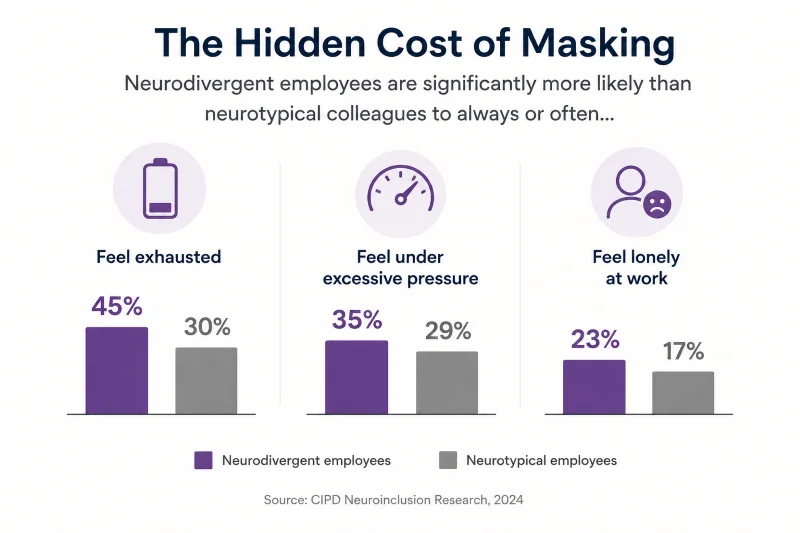
The Hidden Cost of Masking
Masking is what happens when a neurodivergent person spends their working day suppressing their natural way of operating in order to fit in. It is exhausting in a way that is genuinely hard to overstate. It is not just uncomfortable. It is cognitively depleting, and it builds up over time.
The CIPD's 2024 neuroinclusion research found that neurodivergent employees are significantly more likely than neurotypical colleagues to always or often feel exhausted (45% vs 30%), feel under excessive pressure (35% vs 29%), and feel lonely at work (23% vs 17%).
Those numbers show up eventually as burnout, absence, and resignation. The employee who leaves citing "culture fit issues" has often been masking for months.
What Actually Changes When Organisations Step Up
When workplaces move from passive tolerance to active support, the wellbeing picture shifts. Neurodivergent employees who feel understood are more engaged, more productive, and far less likely to leave.
There is also a broader effect. Teams with clearer communication, more explicit processes, and greater psychological safety are better for everyone, neurodivergent or not. Investing in neuroinclusion tends to raise the floor for the whole organisation.
How Does Neurodiversity in the Workplace Influence Employee Retention?
Directly and significantly. Poor neuroinclusion is one of the most consistent but least visible drivers of turnover.
When a neurodivergent employee leaves, they rarely cite their neurodivergence in the exit interview. They say management style. Or flexibility. Or culture fit. These are not wrong answers, they are just proxies for the same underlying issue: the organisation did not make space for how they work best.
The CIPD found that 63% of companies with neuroinclusive practices reported improvements in employee wellbeing, 55% saw stronger company culture, and 53% reported better people management outcomes. These are not isolated effects for a small group of employees. They reflect changes that run through the whole organisation.
Retention also compounds. Experienced neurodivergent employees who leave take their skills, their institutional knowledge, and their perspective with them. Replacing them costs time and money, and the next hire faces the same environment unless something changes.
What Are the Key Benefits of Neurodiversity in the Workplace?
The benefits of neurodiversity in the workplace span productivity, culture, and commercial performance. Here is how they break down in practice:
The unifying thread is cognitive diversity. Teams that all think in the same way share the same blind spots. Teams with a range of cognitive styles catch more, question more, and solve more.

How Can Employers Support a Neurodiverse Workplace?
Supporting a neurodiverse workplace starts with accepting that most current systems were not built with neurodivergent employees in mind, and working backward from there.
Rethink How You Hire
Traditional recruitment processes screen out a significant proportion of neurodivergent talent before they ever reach an interview. Timed assessments, unstructured panel interviews, and group exercises tend to measure social fluency rather than job capability.
Practical alternatives include:
- Sharing interview questions in advance
- Offering task-based or work-sample assessments
- Allowing extra time where needed
- Making it easy for candidates to request adjustments without having to disclose a specific diagnosis
Make Onboarding Explicit, Not Assumed
Most onboarding relies on informal cultural absorption. Watch, observe, and pick it up as you go. For neurodivergent employees, that approach often means weeks of unnecessary confusion and anxiety.
Written role guides, clear expectations from day one, named contacts for different types of questions, and regular structured check-ins make a much bigger difference than any welcome lunch.
Train Managers Before They Need It
Only 46% of managers feel capable of supporting neurodivergent employees, according to CIPD's 2024 research. That is not a judgement on their intentions. It is a training gap.
Managers do not need to become specialists. They need to know how to have a good conversation about adjustments, how to spot signs of struggle that are not the same as underperformance, and where to escalate when they are out of their depth.
- Tip for HR teams: The most effective manager training on neurodiversity is practical and scenario-based, not a one-hour awareness module. Real conversations come from real practice.
Use Data to Guide Your Decisions
Anonymous workforce health data helps organisations understand where different employee groups are experiencing stress, disengagement, or burnout, without requiring individuals to self-identify or disclose. Platforms like Champion Health cover this kind of data-driven wellbeing support across mental health, physical health, and broader workforce risk.

What Challenges Should Employers Expect?
Supporting neurodiversity in the workplace is not complicated in theory. In practice, a few things reliably get in the way.
- Disclosure is harder than it looks. 31% of neurodivergent employees have not told their manager or HR about their condition (CIPD, 2024). Stigma and fear of career consequences are the main reasons. This matters because most support systems activate only after disclosure. The workaround is to make adjustments available by default rather than requiring a formal request to unlock them.
- Performance frameworks often work against neurodivergent employees. Systems built around behavioural competencies, how someone comes across in a meeting, how they manage up, how confidently they present tend to disadvantage people who communicate or process differently. Reviewing these frameworks through a neuroinclusion lens is one of the highest-impact structural changes an employer can make.
- Consistency is the hard part. Many organisations do the right things at the start, through inclusive hiring or thoughtful onboarding, then let habits drift back to the default. Neuroinclusion requires ongoing attention, not a policy document and an awareness week.
Neurodiversity in the Workplace Is an Opportunity Most Organisations Are Leaving on the Table
A fifth of your workforce is, or is likely to be, neurodivergent. Many of them are not working at full capacity because the environment was not built for them. Some have already left for the same reason, without anyone understanding why.
The benefits of neurodiversity in the workplace, stronger problem-solving, better retention, more engaged teams, are not theoretical. They are the documented outcomes of organisations that have made genuine changes. The gap between knowing this and acting on it is where most employers currently sit.
The good news is the changes are not as complex as they might seem. Clearer communication. More flexible processes. Better manager training. A genuine effort to understand what different employees actually need.
That is not a transformation project. It is a series of decisions. And most of them cost very little.
Ready to understand what your workforce actually needs?
Champion Health helps organisations identify where wellbeing risk is building across their workforce, before it becomes burnout, absence, or turnover. Book a demo and see what that looks like in practice.
Frequently Asked Questions
How do I accommodate neurodiversity in the workplace?
Start with adjustments that do not require disclosure: written summaries after meetings, clear and specific feedback, flexible working options, and quiet spaces for focused work. Then build a culture where people feel safe asking for more without fear of judgement. Most accommodations cost little and help the whole team.
Why is neurodiversity important in the workplace?
Around 1 in 5 people are neurodivergent. That means neurodiversity in your workplace already exists, whether it is visible or not. When it is unsupported, you lose productivity, wellbeing, and people. When it is supported, you gain cognitive diversity, stronger problem-solving, and a culture that tends to work better for everyone.
Which neurodivergent conditions are most commonly recognised in business settings?
Autism spectrum conditions, ADHD, dyslexia, and dyspraxia come up most often in workplace inclusion strategies. But the category is broader, including dyscalculia, Tourette's syndrome, and other developmental differences. The condition matters less than understanding that people have different needs and building systems flexible enough to accommodate them.
How can supporting neurodiversity improve team productivity?
Neurodivergent employees often bring cognitive strengths that are genuinely rare: sustained deep focus, pattern recognition, divergent thinking, and high-precision processing. When you remove the environmental barriers that prevent those strengths from showing up, the whole team benefits. Cognitively diverse teams consistently outperform on complex problems.
How can technology or platforms assist in supporting neurodiverse employees?
For employees, flexible digital tools, async communication options, and structured task management reduce a lot of the friction that comes from environments designed for one cognitive style. For HR and leadership, platforms that provide anonymous, aggregated wellbeing data help identify where specific groups are struggling, so support can be proactive rather than reactive.
