

According to the Work-Related Stress, Depression or Anxiety Statistics report, Health and Safety Executive, 2024/25, 964,000 workers in Great Britain are currently suffering from work-related stress, depression, or anxiety, a figure that has more than doubled since records began in 2001.
That’s not just a sobering statistic. For HR leaders and business owners, it represents a very real, very costly problem sitting inside their organisations right now. And yet, a significant number of employers are still responding reactively, waiting for sickness absence or staff turnover to signal that something is wrong, long after the damage is done.
Mental health in the workplace refers to the psychological wellbeing of employees in their work environment, including how work affects people’s mental health and how organisations respond when challenges arise. Done well, it’s not just a welfare issue. It’s a business strategy.
This article breaks down the key trends, the risks of inaction, and the practical steps employers can take in 2026 to genuinely improve how their organisations support people.
What Does the Current State of Mental Health at Work Actually Look Like?
The numbers are hard to ignore. Mental health conditions now account for 52% of all work-related ill health cases in the UK, making them the primary driver of workplace illness (HSE, 2025). Those cases resulted in 22.1 million lost working days in 2024/25 alone, a jump of nearly 6 million days compared to the previous year.
The cost side of the equation is equally stark. Poor mental health costs UK employers an estimated £51 billion per year, according to Deloitte’s 2024 mental health and employers research. The largest single component isn’t absenteeism, it’s presenteeism, where employees show up physically but can’t function properly. That alone accounts for around £24 billion annually.
Which Employees Are Most at Risk?
Burnout and chronic stress aren’t evenly distributed. Certain groups are facing disproportionate pressure:
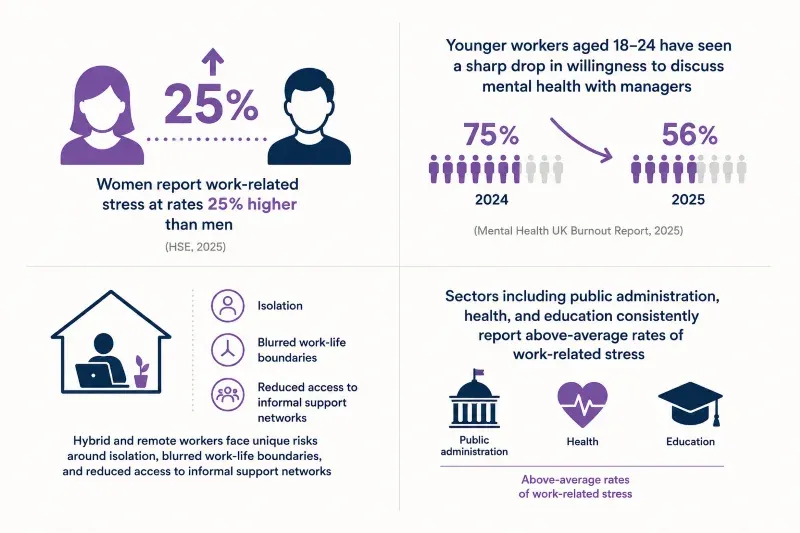
- Women report work-related stress at rates 25% higher than men (HSE, 2025)
- Younger workers aged 18-24 have seen a sharp drop in willingness to discuss mental health with managers, falling from 75% in 2024 to just 56% in 2025 (Mental Health UK Burnout Report, 2025)
- Hybrid and remote workers face unique risks around isolation, blurred work-life boundaries, and reduced access to informal support networks
- Sectors including public administration, health, and education consistently report above-average rates of work-related stress
The picture becomes more concerning when you factor in disclosure: only 13-14% of employees say they feel comfortable discussing mental health at work. Most people are struggling quietly, and that silence makes early intervention almost impossible without the right tools in place.
What Are the Emerging Trends Shaping Workplace Mental Health?
Digital and AI-Powered Health Assessments
One of the most significant shifts in recent years is the move away from annual surveys toward continuous, technology-driven monitoring. Employers are increasingly turning to validated health assessments and analytics dashboards to understand where workforce risk is building — not just when it has already surfaced as absence.
Platforms likeChampion Health use advanced diagnostic technology and AI-informed analysis to give HR and leadership teams a clear picture of mental health trends across their organisation. The key difference from a traditional employee assistance programme (EAP) is the ability to spot patterns early, at a population level, before they escalate into individual crises.
Preventative Thinking Is Replacing Crisis Management
For years, workplace mental health support meant signposting people to counselling once they were already struggling. That model is changing. The most forward-thinking employers are building prevention into the fabric of their organisation - through behavioural analytics, team challenges, regular check-ins, and proactive manager training.
The business case for this shift is clear: Deloitte found a £5 average return for every £1 invested in mental health support. Prevention is not just the right thing to do; it’s also far less expensive than dealing with the downstream effects of burnout, attrition, and long-term sickness.
Integrated Wellbeing: Physical and Mental Health Working Together
Sleep, nutrition, physical activity, and financial stress all affect psychological resilience. Employers who address these in isolation, offering a gym discount here, a stress webinar there, tend to see limited impact.
The trend in 2026 is toward integrated platforms that connect physical and mental health in one place, giving employees and their employers a holistic view of wellbeing.

What Are the Key Risks for Employers Who Ignore Workplace Mental Health?
This is where the conversation often needs to shift for senior leaders who still see mental health as a “nice to have.” The risks of inaction are substantial, specific, and measurable.
| Risk Area | What It Costs You |
|---|---|
| Productivity loss | Presenteeism costs UK employers ~£24bn/year (Deloitte, 2024) |
| Staff turnover | 61% of UK employees who left a role cited poor mental health as a factor |
| Absenteeism | 22.1 million working days lost to stress/anxiety in 2024/25 (HSE) |
| Legal exposure | Failure to manage work-related stress can result in HSE enforcement and civil claims |
| Employer brand | Poor wellbeing culture increasingly affects recruitment and Glassdoor ratings |
Legal and Compliance Considerations
The HSE has made reducing work-related ill health, with a specific focus on mental health, a primary objective in its 2025/26 business plan. That means increased scrutiny. Employers have a legal duty under the Health and Safety at Work Act 1974 to assess and manage the risk of work-related stress, just as they would any physical hazard.
An employer who cannot demonstrate reasonable steps to manage psychosocial risk is increasingly exposed, both to regulatory action and to civil claims from employees who suffer harm. This isn’t a remote possibility: it’s a risk that is growing year on year.
How Can Employers Meet Their Responsibilities for Supporting Mental Health in the Workplace?
Build a Culture Where People Actually Feel Safe Talking
No programme works if the culture doesn’t support it. That means visible commitment from leadership, manager training on having difficult conversations, and genuine efforts to reduce the stigma around mental health. Managers don’t need to become therapists — but they do need to know how to notice when someone is struggling and how to respond without making things worse.
Key actions here include:
- Delivering mental health awareness training across all management levels
- Ensuring senior leaders model open conversations about stress and wellbeing
- Creating anonymous feedback channels where employees can flag concerns early
- Reviewing workloads and job design as a routine part of people management
Implement Programmes That Go Beyond the EAP
Traditional EAPs are underused, often because employees don’t know about them, don’t trust them, or don’t engage until they’re already in crisis. Supporting mental health in the workplace means meeting people earlier and more proactively.
This includes access to therapy and coaching, but also lower-intensity support like digital tools for mindfulness, sleep, and stress management that employees can use daily. The goal is to create multiple touchpoints, not a single help line that most people never call.
Update Policies to Reflect How Work Has Changed
Hybrid working, always-on communication culture, and economic pressures have changed the psychological contract between employers and employees. Policies that haven’t been reviewed in the last two years are likely out of step with how work actually happens now.
A practical review should cover:
- Mental health and stress policies: are they specific, communicated, and enforced?
- Flexible working arrangements: are they genuinely available, or just on paper?
- Return-to-work processes: do they support gradual reintegration after mental health absence?
- Right to disconnect: is there a clear expectation around out-of-hours communication?
Use Data to Understand What’s Actually Happening
One of the most common blind spots in workplace mental health is the gap between what leaders think is happening and what employees are actually experiencing. Anonymous, aggregated health data fills that gap. Champion Health’s tool gives HR teams and senior leaders a real-time view of workforce wellbeing, identifying where risk is building by team, department, or location, before it becomes a crisis.
This kind of data-informed approach is what separates reactive organisations from those that are genuinely ahead of the problem.

How to Improve Mental Health in the Workplace: A Practical Framework for 2026
Improving mental health in the workplace doesn’t happen through a single initiative. It requires a layered, consistent approach. Here’s where to start:
- Run validated health assessments. Understand the current state of workforce mental health with data, not assumptions. Look for platforms that use clinically validated tools rather than generic pulse surveys.
- Provide access to professional support. This includes therapy, coaching, and digital mental health tools, not just an EAP phone number buried in an intranet page.
- Offer meaningful flexibility. Flexible working arrangements genuinely reduce stress, but only if managers are empowered to support them without creating informal penalties for those who use them.
- Train managers, not just HR. Mental health issues surface first in team relationships. Line managers are the first line of support; they need skills, confidence, and clear escalation pathways.
- Run wellbeing challenges and engagement programmes. Team-based activities around physical activity, sleep, and nutrition build psychological resilience and community.
- Foster peer support networks. Mentoring programmes, mental health champions, and peer support groups reduce isolation and normalise conversations about wellbeing.
- Track outcomes, not just activities. Measure the impact of what you’re doing, through assessment scores, absence rates, engagement data, and retention metrics. Programmes that can’t demonstrate impact don’t scale.
One investment worth making: a platform that connects all of these elements in one place, covering mental health alongside physical activity, sleep, nutrition, and financial wellbeing. Champion Health does exactly that, giving HR teams and leadership a single view of where their organisation stands, and what to prioritise next.
The Risks Employers Need to Anticipate (Not Just React To)
Even well-intentioned mental health programmes carry risks if not implemented carefully:
- Creating a tick-box culture. If mental health initiatives feel performative, they actively damage trust. Employees notice the gap between stated values and day-to-day management behaviour.
- Over-relying on self-referral. Not everyone who needs support will seek it out. Proactive identification of risk, through regular assessments and behavioural data, is essential to reaching people before they disengage.
- Ignoring the work itself. Many mental health programmes focus on building individual resilience without addressing the structural causes of stress: excessive workloads, poor management, and lack of autonomy. Support is not a substitute for genuinely manageable work.
- Failing to protect data trust. Employees will only engage with wellbeing tools if they trust that their data is anonymous and secure. Any platform used for health data must be transparent about how data is stored, aggregated, and reported.
Proactive Mental Health Support Is a Business Imperative in 2026
The organisations that will manage workforce wellbeing most effectively in 2026 are those that treat mental health data with the same rigour they apply to financial data: regularly collected, carefully analysed, and acted upon before problems compound.
A workforce where stress goes undetected and support comes too late doesn’t just affect individuals; it affects productivity, retention, and the employer’s ability to grow. The tools to do this well now exist. The business case is proven. What’s left is the decision to make it a genuine organisational priority rather than an HR footnote.
Ready to understand what’s really happening across your workforce?
Book a free demo of Champion Health to see how advanced diagnostic technology and AI-informed analytics can help your organisation identify mental health risk before it becomes sickness absence, attrition, or burnout.
Frequently Asked Questions
How do I promote mental health and wellbeing in the workplace?
Start with regular, anonymous health assessments to understand what your workforce is experiencing. From there, build support across multiple channels, professional counselling, digital tools, manager training, and peer support networks. The key is consistency; one-off initiatives rarely move the dial.
How do I reduce mental health stigma in the workplace?
Stigma reduces when senior leaders openly acknowledge mental health as a legitimate workplace issue, and managers are trained to handle conversations with confidence rather than avoidance. Embedding mental health topics into regular team discussions, rather than isolating them in awareness weeks, normalises the subject over time.
Why is mental health important in the workplace?
Mental health conditions now account for 52% of all work-related ill health in the UK and cost employers an estimated £51 billion per year (Deloitte, 2024). Beyond the financial case, employees who are psychologically well are more engaged, more productive, and significantly less likely to leave. Supporting mental health is both a legal responsibility and a driver of business performance.
What are the early warning signs of poor mental health among employees?
Common indicators include increased absenteeism, reduced productivity or quality of work, withdrawal from team interactions, irritability or mood changes, and declining engagement scores. Managers trained to spot behavioural shifts, combined with regular anonymous health assessments, are the most effective early warning system.
How can employers measure the ROI of mental health initiatives?
Track a combination of leading and lagging indicators: health assessment scores over time, sickness absence rates, staff turnover, and engagement survey results. Deloitte’s research provides a useful benchmark: well-designed mental health programmes return an average of £5.30 for every £1 invested. Platforms like Champion Health provide analytics dashboards that make this measurement straightforward.